
The Perpendicular Principle: How Grain Alignment in Veneer Drying is Revolutionizing Yield and Quality in the Woodworking Industry
In the highly specialized, multi-billion-dollar world of engineered wood products, where microns and moisture percentages dictate profit margins, a seemingly simple principle is often the difference between premium-grade success and costly, subpar failure. This principle, known in industry parlance as the "Perpendicular Principle," dictates that wood veneer must be fed into a continuous roller dryer with its grain running perpendicular to the direction of the rollers. While it may appear to be a minor logistical detail, this single factor is a cornerstone of modern veneer processing, influencing everything from structural integrity and aesthetic appeal to energy efficiency and operational safety.
For decades, the art of drying veneer was just that—an art. But as science, technology, and market demands have evolved, that art has been refined into a precise science. At the heart of this science is a fundamental understanding of wood's anisotropic nature: its properties are directionally dependent. Ignoring this fundamental truth, as many smaller operations still do, is to leave significant value on the table—or, more accurately, to see it shattered on the factory floor.
The Anatomy of a Veneer Dryer: A High-Stakes Conveyor
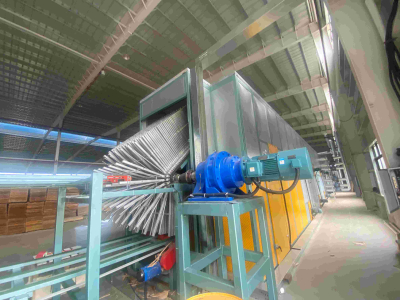
To understand the "why" behind the Perpendicular Principle, one must first understand the "how" of a modern veneer dryer. These are not simple ovens; they are intricate, multi-zone thermal processing systems. A typical single-pass or multi-pass continuous roller dryer is a long, tunnel-like structure, often exceeding 50 meters in length. Inside, a series of heated rollers—powered by steam, thermal oil, or electricity—both transport the thin sheets of veneer and apply conductive heat.
The environment within is brutal. Temperatures can range from 150°C to 220°C (300°F to 430°F), and the goal is to rapidly yet controllably reduce the moisture content of the freshly peeled or sliced veneer from a saturated 30-60% down to a stable 5-8%. This process must happen quickly to maintain production line speed, but also gently enough to avoid damaging the delicate, often paper-thin, wood sheets.
"The dryer is the heart of the veneer production line," explains Dr. Elara Vance, a materials scientist at the Nordic Forest Research Institute. "It's where the veneer is 'set.' It's not just about removing water; it's about setting the final dimensions, stabilizing the wood fibers, and preparing the sheet for the pressures of the pressing process that will follow. Any flaw introduced here is a permanent, and often magnified, flaw in the final plywood, LVL, or furniture panel."
The Core Reason: A Battle of Forces Along the Grain
Wood is a natural composite material. Its long, tubular cellulose fibers, bound together by a matrix of lignin and hemicellulose, form channels that run parallel to the direction of the tree's growth—this is the grain direction. These channels are highways for water movement when the tree is alive. In the dryer, this structure dictates how the wood reacts to stress and heat.
1. Tensile Strength and the Pull of the Rollers:
The primary mechanical reason for the perpendicular feed is the vast difference in wood's tensile strength along the grain versus across it. Tensile strength along the grain can be 10 to 20 times greater than its tensile strength across the grain.
When the veneer is fed into the dryer, the powered rollers exert a pulling force. If the veneer is fed with the grain parallel to the rollers, this pulling force is applied across the grain. The weak cross-grain bonds are the only thing resisting this tension. The result is a high probability of splitting and tearing at the edges, a common defect known as "edge-checking." These tears can propagate deep into the sheet, rendering large portions of the veneer unusable.
Conversely, when the grain is perpendicular to the rollers, the pulling force is applied along the grain. The immensely strong longitudinal fibers are now bearing the load. The veneer can withstand the high tension required for smooth transport through the dryer without tearing, dramatically reducing breakage and maximizing usable yield.
2. Shrinkage: The Inevitable Force That Must Be Managed
As water is driven out of the wood cell walls, the veneer shrinks. Crucially, wood shrinks most significantly in the direction perpendicular to the grain (tangentially) and very little along the grain (longitudinally). This differential shrinkage is a powerful, destructive force if not properly managed.
Parallel Feed Catastrophe: Imagine a sheet of veneer fed with grain parallel to the rollers. As it moves through the dryer, it wants to shrink significantly in width (across the grain). However, the rollers, which are gripping the edges of the sheet, prevent this natural shrinkage. This creates immense internal cross-grain stresses. The wood, unable to contract freely, relieves this stress by cracking and splitting. It's like trying to prevent a rubber band from contracting—something must give, and in the case of veneer, it's the wood itself that fails.
Perpendicular Feed Harmony: Now, consider the perpendicular feed. The grain runs across the machine direction. As the veneer dries, it wants to shrink significantly along its width, which is now parallel to the axis of the rollers. Because the rollers are only contacting the veneer along its now much longer edges (the edges running with the grain), they do not restrain this primary shrinkage. The veneer is free to contract in the direction it naturally wants to, gliding smoothly over and between the rollers. The minimal longitudinal shrinkage occurs along the length of the sheet, which is easily accommodated by the slight slippage and controlled tension of the roller system.
3. Curl and Flatness: Delivering a Stable Product
Veneer that is dried under the wrong stress conditions will rarely lie flat. The internal stresses from restrained shrinkage or misaligned tension often manifest as severe curling, cupping, or twisting once the veneer exits the dryer. This creates a nightmare for downstream processes, particularly the critical layup and hot-pressing stages where flat, uniform sheets are essential for creating a strong, void-free bond.
"A curled veneer is a reject veneer for automated layup lines," says Karl Schmidt, a production manager at a large German plywood manufacturer. "It jams the machinery, it creates air pockets in the press that lead to delamination, and it requires manual intervention, which slows everything down and increases labor costs. Ensuring a perpendicular feed is the single most effective way to guarantee the flat, stable sheets that our presses demand."
Beyond the Obvious: The Ripple Effects on Quality and Efficiency
The benefits of adhering to the Perpendicular Principle extend far beyond simply preventing breakage.
Moisture Content (MC) Uniformity: When veneer tears or curls, it creates irregular pathways for hot air in a convective dryer or poor contact with heated rollers. This leads to uneven drying—some areas become bone-dry and brittle (over-dried), while others remain damp (under-dried). Inconsistent MC in the final product leads to warping, glue-line failures, and internal stresses in the finished panel. Perpendicular feeding promotes uniform contact and airflow, leading to a consistently dried product.
Surface Quality and "Case-Hardening": For delicate face veneers used in furniture and cabinetry, surface checking (micro-cracks) is a critical defect. Restrained shrinkage from parallel feeding can induce these checks. The perpendicular method allows the wood to shrink naturally, preserving the integrity of the surface cells and resulting in a superior aesthetic finish.
Energy Efficiency: A process with less breakage and more consistent drying is inherently more efficient. Every sheet that tears is wasted energy. Every minute spent clearing a jam or re-feeding a curled sheet is lost productivity. By optimizing the process from the start, dryers run smoothly, require less intervention, and consume less energy per cubic meter of finished veneer.
Operational Safety: Broken veneer strands wrapping around high-speed rollers, jams that require manual clearing in a hot environment, and the general unpredictability of a misaligned process all contribute to safety hazards. A streamlined, perpendicular-feed process is a safer and more predictable one.
Implementing the Principle: Technology and Training
Knowing the principle is one thing; implementing it flawlessly on a fast-moving production line is another. This is where technology plays a crucial role.
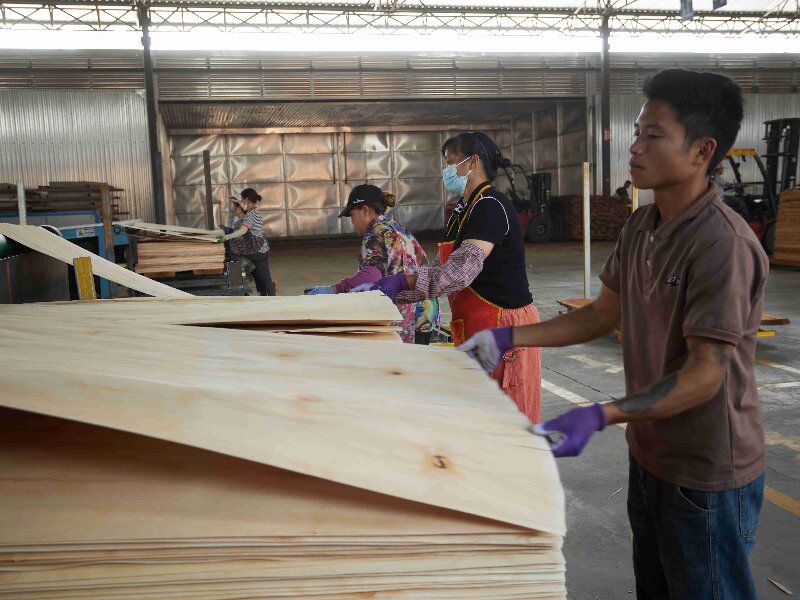
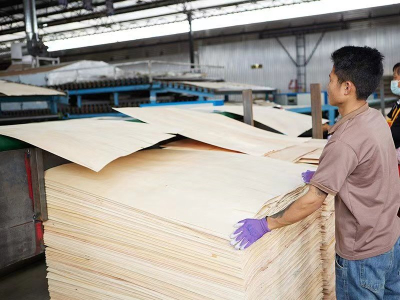
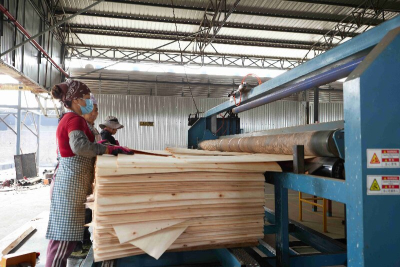
Modern veneer drying lines are equipped with sophisticated infeed systems. After the veneer is clipped into sheets, it is often conveyed to a "jumper" or stacking system that can rotate the sheet 90 degrees before it is automatically fed into the dryer. Laser-guided alignment systems can ensure the sheet is perfectly squared before entry.
"Automation is key," states Anya Sharma, CEO of VeneerTech Solutions, a leading equipment supplier. "Our V-Align 5000 system uses machine vision to scan the grain direction of each incoming sheet and makes micro-adjustments to the feed conveyor to ensure a perfect perpendicular entry, even if the sheet is irregularly shaped. This level of precision, which was unthinkable 20 years ago, is now becoming the industry standard for high-end producers."
However, technology alone is not enough. Comprehensive operator training is vital. Workers must understand the why behind the rule. "You can have the best equipment, but if an operator on the line doesn't understand the catastrophic effect of letting a few sheets slip through parallel to the rollers, you will still have quality issues," Sharma adds. "It's about building a culture of quality where the Perpendicular Principle is non-negotiable."
A Case Study in Transformation: The Story of SilvaBoard Ltd.
SilvaBoard Ltd., a mid-sized panel manufacturer in Poland, serves as a powerful testament to the principle's impact. Two years ago, the company was struggling with a 12% rejection rate on its premium oak veneer line, primarily due to edge-checking and curl.
"We assumed our dryer was faulty or our temperature profiles were wrong," recalls Plant Director, Piotr Nowak. "We spent thousands on servicing and consultants. It was a veteran line operator, Janina, who finally pointed out the obvious. We were so focused on clipping and feeding for speed that we weren't consistently rotating the sheets. The grain was often entering at a slight angle, sometimes even parallel."
The company invested in a semi-automatic rotary feeder and, more importantly, launched a rigorous training program centered on the science of wood grain. The results were transformative.
"Within three months, our rejection rate on that line dropped to under 3%," says Nowak. "Our yield increased dramatically, our energy consumption per sheet dropped by 8%, and the consistency of our product allowed us to move into more lucrative, contract-based furniture supply. Janina's simple observation, grounded in a fundamental truth about wood, saved our premium line and fundamentally changed our approach to process control."
Conclusion: Not Just a Rule, But a Foundation
In the relentless pursuit of efficiency and quality, the wood products industry is increasingly turning to automation, AI, and advanced material science. Yet, these sophisticated solutions must be built upon a foundation of fundamental truths. The requirement to feed veneer perpendicular to the dryer rollers is one such truth.
It is a perfect synergy of material science and mechanical engineering—a deep respect for the innate nature of wood guiding the design and operation of complex industrial machinery. It is a principle that prevents waste, enhances quality, saves energy, and ensures safety. For any enterprise involved in the transformation of a log into a sheet of valuable veneer, it is not merely a best practice or a line item in a manual. It is, unequivocally, the law of the line. As the industry continues to evolve, this perpendicular principle will remain the unwavering baseline upon which all other innovations will depend.