

News Center

Factories looking to upgrade from manual handling to automatic infeed and stacking often focus solely on the new equipment. In plywood veneer drying, this can easily lead to a costly mismatch. A faster feeder, for example, won't necessarily increase daily output if the veneer dryer machine,…
2026/09/11 17:25

Achieving peak output in continuous plywood production isn't solely about acquiring a high-capacity veneer dryer. True efficiency hinges on harmonizing automatic plate feeding, discharge handling, stacking, heat-source operation, and worker rhythm with the dryer's pace. Before scaling up plywood…
2026/09/11 17:23

Often, a buyer initially focuses on a simple 110 m³/day target when discussing a veneer dryer machine, but daily output alone doesn't define a workable plywood factory plan. A practical project must translate this target into hourly throughput, operating hours, electricity consumption, biomass fuel…
2026/09/10 14:11

For plywood mills drying core veneer with modest flatness requirements, the most advanced roller line isn't always the best initial choice. Choosing a suitable veneer dryer means aligning it with the veneer type, target moisture level, available floor space, and investment plan. Shine Machinery's…
2026/09/10 14:07

In plywood production, selecting the optimal drying method hinges on the veneer's intended use. Core veneer, partial surface veneer, bottom veneer, and architectural core face veneer don't always demand identical drying outcomes. A Vertical Veneer Dryer can be a robust, economical solution for…
2026/09/10 14:05
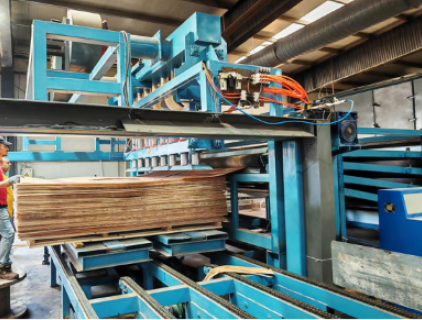
When manual plate loading is uneven, a dryer with strong rated capacity can still fall short of its target output for a full shift. In plywood production, feeding, drying, and collection function as a single continuous flow. The real question isn't just how fast an automatic feeder can operate, but…
2026/09/04 17:06
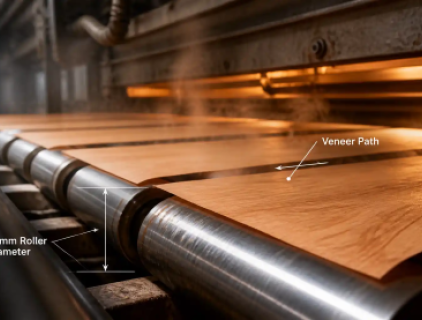
A veneer dryer machine quotation can look persuasive when it lists output, length, heating method, and price. Yet one small mechanical detail can change the whole purchasing judgment: roller diameter. When a model such as GTH30-20 is discussed without clear roller diameter, roller spacing, roller…
2026/09/04 17:03
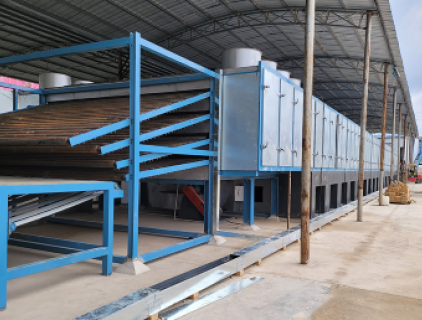
For a plywood plant targeting 15–18 m³/h, the primary focus shouldn't be a six-deck dryer's power. Instead, prioritize production time. Veneer dryer selection hinges on actual shift output, veneer thickness, incoming/target moisture, heat source, labor, and total drying cost. Deck count is crucial…
2026/09/04 16:59
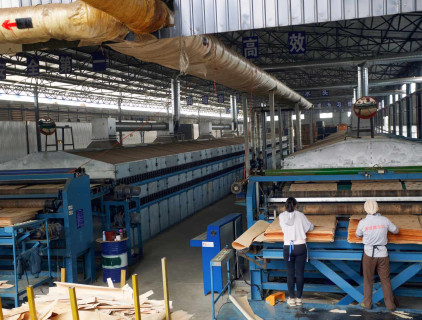
End ripples, wrinkles, cracks, and uneven moisture after plywood veneer drying are often seen as sorting problems. In practice, sheet rejection is only the final response. Instead, start by examining the full heat-exchange journey inside the veneer dryer machine: how veneer enters, how hot air…
2026/09/03 17:45
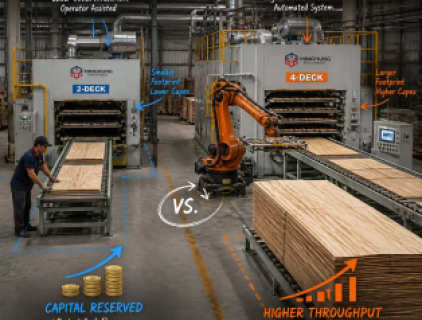
When a plywood plant needs around 36 m³ of dried veneer per day but cannot easily expand its workshop, the immediate question isn't “Which catalogue says 36 m³/day?” Instead, consider this: Which Veneer Drying System can match the required hourly output, moisture target, veneer type, and available…
2026/09/03 17:43
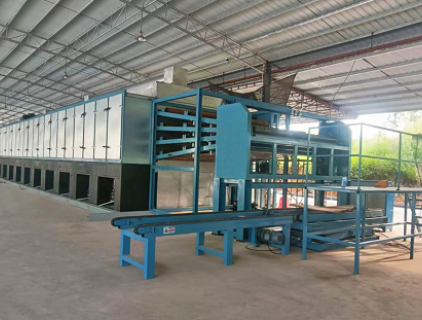
When a plywood factory transitions from standard shifts to continuous production, the dryer's discharge end frequently becomes the initial point where staffing challenges emerge. Manual workers may have, for years, absorbed irregular veneer flow, accelerating stacking during peak periods and…
2026/08/28 17:29
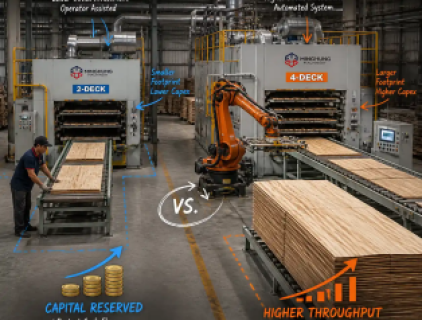
For plywood manufacturers, achieving a higher level of automation doesn't always translate into a better investment. If semi-automatic handling already keeps a veneer dryer machine operating at its required feed rate, immediately upgrading to a fully automatic system might tie up capital. That same…
2026/08/27 16:29