
Vertical Veneer Dring Machine
Economical Investment and Operation – The purchase price is approximately one‑third that of a roller dryer with equivalent output. Total drying cost (energy + labour + maintenance) is less than USD 8 per cubic metre, representing only 30‑60% of conventional drying expenses.
Space‑Saving Footprint – Occupying just one‑third of the floor space required by roller dryers, the vertical unit frees up valuable workshop area for other production lines or storage. This is especially beneficial for plants with limited real estate.
Superior Product Quality – Uniform airflow and precise temperature control minimise common defects such as surface cracking, cupping, twist, and discoloration. The final moisture content can be consistently maintained between 5‑16%, meeting strict plywood and furniture standards.
Zero Jamming and High Uptime – Because there are no horizontal rollers to trap sheets, production runs continuously without interruption. This reduces scrap rates and boosts overall equipment effectiveness (OEE).
Energy Efficiency – The insulated chamber and recirculation system recover waste heat, while the direct‑burn option eliminates the energy loss associated with external boilers. Many models also offer heat recovery from exhaust gases.
Labour Savings – The fully automated feeding and discharging process requires only one operator for monitoring, drastically reducing manual handling compared to batch‑type dryers.
Scalability – Available in various sizes and layer counts, the machine can be tailored to match production capacities from 1.5 m³/h up to 6 m³/h, accommodating both small workshops and large industrial mills.
Product Structure
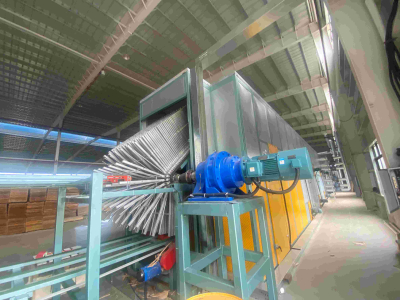
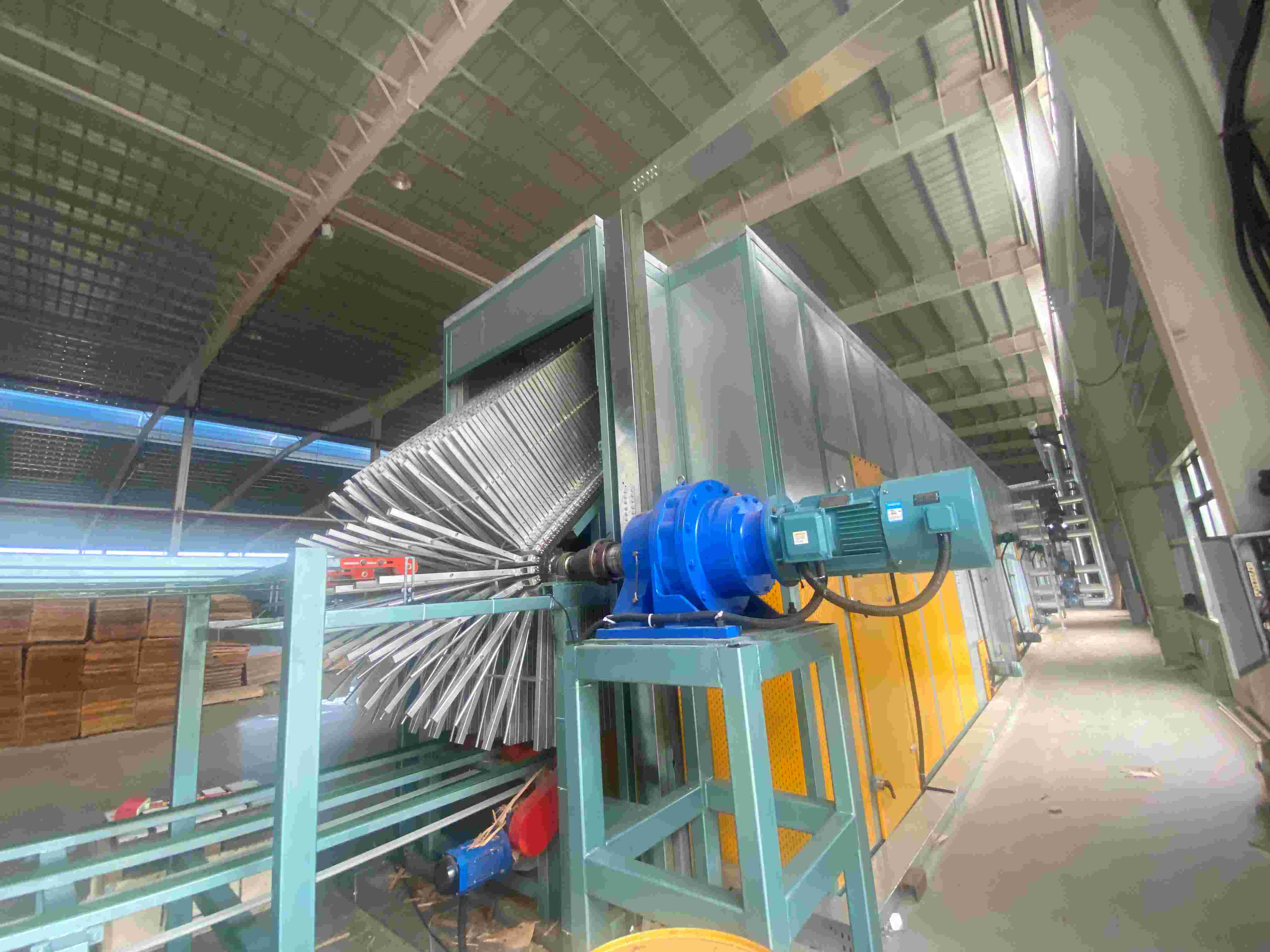
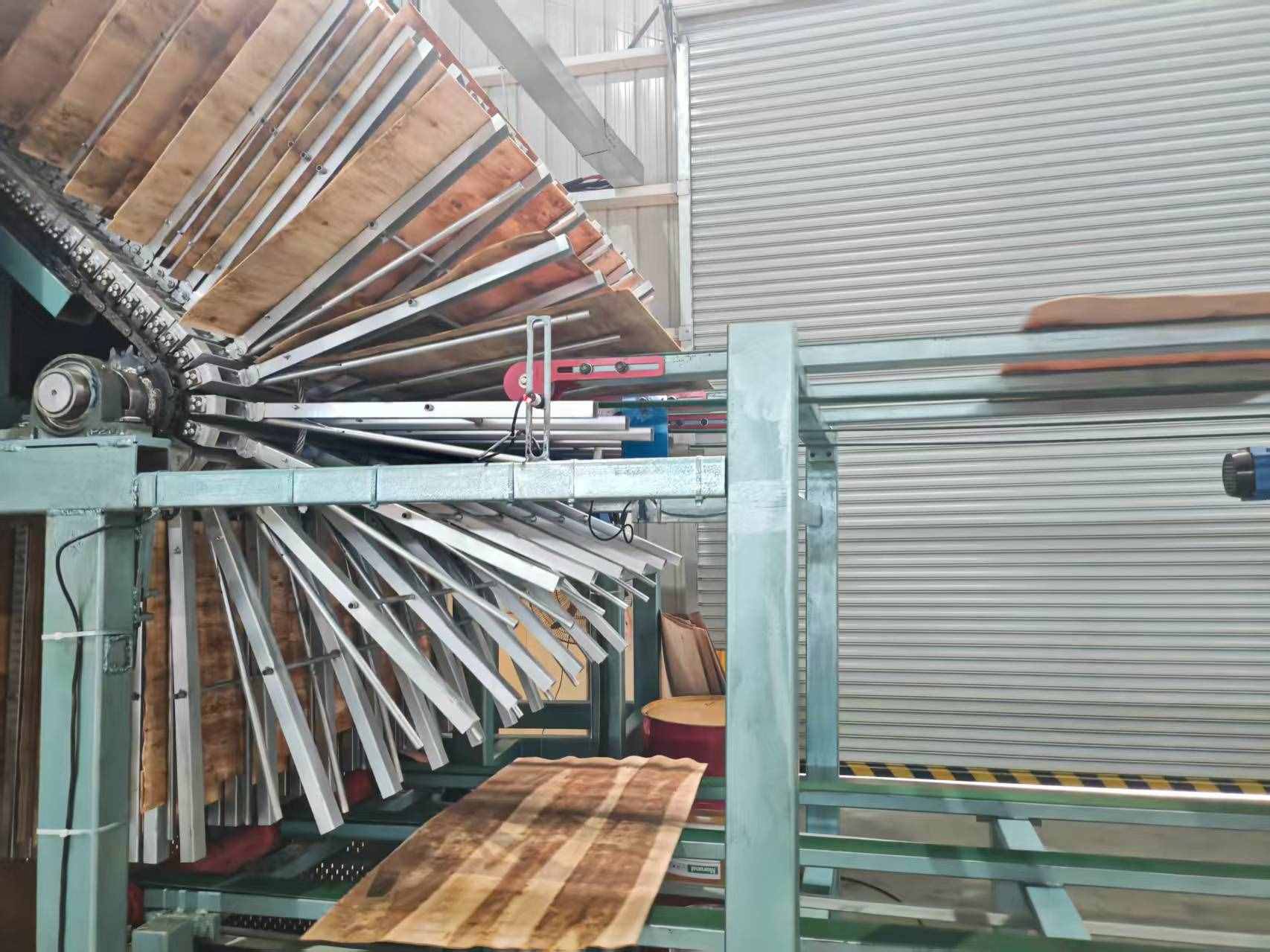
The machine is built around a rigid steel frame that supports four integrated functional zones, arranged in a linear flow from feeding to discharging.
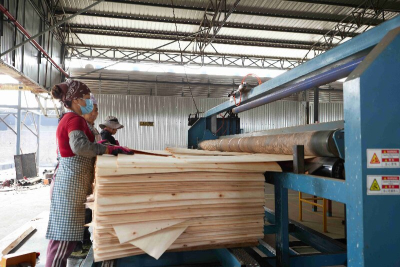
Feeding Section – Equipped with an infeed conveyor and a precise alignment mechanism that guides each veneer sheet vertically into the drying chamber. Automatic layer‑by‑layer loading ensures consistent spacing between sheets.
Heating Section – The core of the machine, consisting of multiple vertical heating plates or racks that hold the veneers in a perpendicular position. Hot air is forced through the gaps between plates by a high‑efficiency circulation fan system. The heat source (steam, thermal oil, hot water, or flue gas from a biomass burner) is transferred via finned heat exchangers. Temperature is adjustable from 60°C to 160°C, with intelligent PID controllers maintaining uniform heat across all layers.
Cooling Section – After drying, the veneers pass through a forced‑air cooling zone that gradually reduces their temperature to prevent warping or stress release. This section also stabilises the final moisture content before stacking.
Discharging Section – A take‑off conveyor collects the dried veneers and delivers them to the stacking station. The discharge speed is synchronised with the drying cycle to enable continuous, uninterrupted operation.
Additional structural elements include a heavy‑duty chain drive system that moves the veneer carriers vertically and horizontally within the oven, as well as an insulated outer casing that minimises heat loss. Depending on the model, the machine may have 20 to 40 layers, accommodating veneer widths up to 2800 mm and thicknesses from 1.0 mm to 4.0 mm.
Product Features
The Vertical Veneer Drying Machine incorporates several distinctive technical characteristics that directly contribute to its performance:
Vertical Plate Transmission – Veneers are positioned perpendicular to the floor, allowing gravity to assist in keeping them flat and preventing sagging. This design also enables much higher stacking density compared to horizontal systems.
Countercurrent Hot‑Air Circulation – Heated air flows in a countercurrent direction relative to the veneer movement, ensuring each sheet is exposed to fresh, dry air as it progresses. This results in rapid, even moisture extraction without hot spots.
Anti‑Jamming Mechanism – The vertical layout eliminates the risk of veneer overlap or entanglement, a common problem in roller dryers. The machine runs smoothly without board blockages, reducing unplanned stops.
Multi‑Fuel Adaptability – The heating system can be configured for steam, thermal oil, natural gas, diesel, or direct biomass combustion (using waste wood, bark, or off‑cuts). This flexibility allows plants to choose the most cost‑effective and locally available energy source.
Modular Temperature Control – Each section can be independently adjusted, enabling custom drying profiles for different wood species and initial moisture levels. The system also features over‑temperature alarms and automatic shutdown for safety.
High‑Density Loading – With up to 30–40 layers and capacities of 480 sheets per cycle, the machine achieves three to four times the loading capacity of roller dryers within the same floor area.
Low Maintenance Design – All drive components are easily accessible; the chain system requires minimal lubrication, and the heating plates are resistant to corrosion and warping.
Product Applications
The Vertical Veneer Drying Machine is the drying backbone for multiple segments of the wood‑based panel industry. Its versatility makes it suitable for:
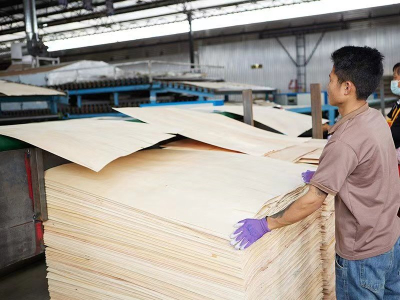
Plywood Manufacturing – Dries core veneer, face veneer, and back veneer for both interior and exterior plywood grades. It handles softwoods (pine, fir) and hardwoods (oak, birch, eucalyptus) with equal efficiency.
Furniture Components – Prepares decorative and structural veneers used in cabinet doors, tabletops, and shelving. Precise moisture control ensures dimensional stability during subsequent glue application and pressing.
Engineered Flooring – Dries the top wear layer and substrate veneers for multi‑layer parquet and laminate flooring. The gentle drying cycle prevents stress fractures that could compromise floor durability.
Decorative Panels and Wall Cladding – Processes high‑quality figured veneers for interior design, where appearance is critical. The uniform drying retains natural grain and colour.
Construction Formwork – Dries thick (up to 4 mm) veneers used in concrete shuttering systems, where strength and flatness are paramount.
Specialty Products – Also applicable for drying bamboo strips, fibreboard mats, and certain non‑wood materials that require similar moisture reduction.
The machine is particularly well‑suited for the “cut‑first‑then‑dry” production flow, as it accepts pre‑cut veneer sizes without the risk of tearing that occurs in roller dryers. Moreover, its ability to handle varying thicknesses (from 1.0 to 4.0 mm) makes it a flexible solution for mills that process multiple product lines.