
How to Match Your Vertical Veneer Dryer with Different Log Species for Optimal Output
In plywood manufacturing, the vertical veneer dryer has become an indispensable asset for producers seeking compact footprints and energy-efficient drying. But owning the right equipment is only half the battle. The real challenge lies in understanding that different log species demand different drying approaches. What works perfectly for poplar can ruin a batch of oak. What speeds up pine can cause severe checking in birch.
Many operators treat their vertical veneer dryer as a one-size-fits-all machine, running the same temperature and conveyor speed regardless of the species entering the feed. This is a costly mistake. Drying veneer is not a uniform process—it is a species-specific science that requires careful calibration of temperature, airflow, and residence time.
This article provides a practical framework for matching your vertical veneer dryer settings to the unique characteristics of different log species. By understanding the drying behaviour of hardwoods versus softwoods, adjusting multi-zone temperature profiles, and leveraging modern control systems, you can achieve optimal output, minimize defects, and maximize the value of every log.
Understanding Why Species Matter in Veneer Drying
Before adjusting any dial on your vertical veneer dryer, you must appreciate why different wood species behave so differently under heat. The answer lies in three fundamental factors: initial moisture content, wood density, and cellular structure.
Initial moisture content varies dramatically between species and even between heartwood and sapwood of the same log. For typical western softwoods, heartwood averages 35–40% moisture content while sapwood ranges from 100–130%. Southern softwoods show similar patterns, with sapwood averaging 100–120%. This means a vertical veneer dryer processing mixed species must handle veneers entering with moisture contents ranging from 35% to over 130%—a fourfold variation.
Wood density and cellular structure further complicate matters. Different tree species have vastly different pit sizes and pit membrane pore structures. These microscopic features determine how easily moisture migrates to the surface during drying. Dense hardwoods like oak have smaller, more restrictive pathways, requiring gentler, longer drying cycles. Lightweight softwoods like pine have more open structures, allowing faster moisture release but also increasing the risk of over-drying and brittleness.
The vertical veneer dryer, with its extended residence time of 1 to 2 hours compared to just 13–15 minutes in roller dryers, offers more control over these species-specific variables. But that control must be exercised deliberately.
Setting Temperature Zones for Different Wood Types
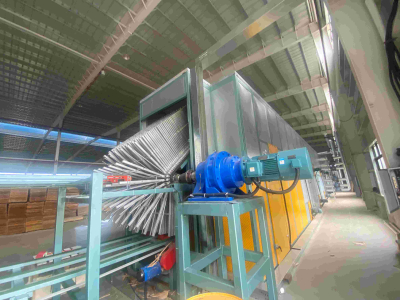
Modern vertical veneer dryers typically feature multi-zone temperature control, allowing operators to create distinct thermal environments along the drying path. This zoning capability is essential for matching your vertical veneer dryer to different log species.
For oak veneers, which are notoriously prone to checking and surface cracking, a gentle drying profile is essential. Oak requires temperatures around 150°C with low airflow to slowly release moisture. Aggressive heating causes the surface to dry and shrink faster than the interior, creating stress that manifests as cracks. In a vertical veneer dryer processing oak, the first zone should be set cooler—perhaps 130–140°C—to allow gradual warming, with subsequent zones incrementally increasing to 150–155°C. The extended residence time of the vertical configuration works in your favour here, allowing moisture to equalize without the need for extreme temperatures.
Pine veneers present the opposite scenario. Pine can tolerate faster drying at higher temperatures—typically 145°C with high airflow to accelerate evaporation without damage. Southern pine veneers have been successfully dried at temperatures ranging from 300°F to 400°F in impingement-type systems. For a vertical veneer dryer handling pine, you can set the first zone at 155–160°C and maintain that range throughout, using higher airflow to drive off moisture quickly. The key is to ensure the dryer speed matches the rapid drying rate so veneers don't remain in the heat longer than necessary.
Poplar and eucalyptus sit somewhere in between. Poplar veneer, typically 2mm thick, dries in about 8–15 minutes at 160–180°C in conventional systems. In a vertical veneer dryer, with its longer path, you can use lower temperatures—140–160°C—and rely on the extended residence time to achieve uniform moisture content. Eucalyptus responds well to temperatures of 120–160°C, with the vertical design's even heat distribution helping to prevent the warping that often plagues this species in roller dryers.
Adjusting Conveyor Speed and Residence Time
The vertical veneer dryer's conveyor speed directly determines how long each veneer spends in the heated zone. This residence time must be calibrated to the species being processed.
Thicker veneers naturally require more time. For 0.8mm veneers, a vertical veneer dryer might run at higher speeds, while 8mm veneers need slower advancement to allow complete moisture removal. But species variation adds another layer. A 2mm oak veneer may need the same residence time as a 3mm poplar veneer because oak's density slows moisture migration.
Drying time reductions of 35% are possible when comparing different species under identical conditions. This means if your vertical veneer dryer is set up for pine, switching to oak without adjusting speed will almost certainly result in under-dried veneer—or force you to raise temperatures to dangerous levels. The solution is to maintain a species-specific speed chart for your operation, documenting the optimal conveyor speed for each species and thickness you process.
Modern vertical veneer dryers equipped with automatic control systems can adjust speed dynamically based on real-time moisture readings. This transforms drying from an experience-driven craft into a data-driven process, ensuring consistent output regardless of species variation.
Managing Airflow and Humidity for Species-Specific Results
Temperature and speed are not the only variables. Airflow and humidity management within the vertical veneer dryer significantly affect drying quality, and different species respond differently to these factors.
Oak veneers, prone to checking, benefit from lower airflow that reduces the evaporation rate at the surface. High-velocity air strips moisture from the surface too quickly, creating a steep moisture gradient that leads to stress cracks. In a vertical veneer dryer, you can adjust damper settings or fan speeds to create a gentler air movement pattern for oak.
Pine and poplar, with their more open cellular structures, can handle higher airflow without surface damage. Higher air velocity accelerates moisture removal and can reduce overall drying time, increasing the throughput of your vertical veneer dryer when processing these species.
Humidity control is equally critical. The vertical veneer dryer's extended residence time means veneers are exposed to the drying environment for much longer than in roller systems. If humidity is too low throughout the dryer, even slow-drying species like oak can lose moisture too quickly in the later stages. Multi-zone humidity control allows you to maintain higher relative humidity in the early zones (preventing case-hardening) and lower humidity in the final zones (achieving target moisture content).
Species-Specific Drying Guidelines for Common Woods
Drawing on practical operational experience and manufacturer recommendations, here are practical starting points for matching your vertical veneer dryer to common log species.
For oak (red oak, white oak, and hickory), use a conservative temperature profile: 130–140°C in zone one, 145–150°C in zone two, and 150–155°C in zone three. Keep airflow moderate—around 500–800 m³/h—to prevent surface checking. Target final moisture content of 6–8% for flooring applications or 8–10% for general plywood. Oak's density means residence time should be at the higher end of your dryer's range.
For pine (southern pine, radiata pine), adopt a hotter, faster approach: 155–165°C across all zones with airflow of 1200–1500 m³/h. Radiata pine veneer has been successfully dried at dry-bulb temperatures of 155–200°C. Target moisture content of 8–10%. The vertical veneer dryer's ability to handle high temperatures makes it particularly well-suited to pine processing.
For poplar, set temperatures at 150–170°C with moderate airflow. Poplar dries relatively quickly and uniformly, making it one of the easier species for the vertical veneer dryer. Target 8–10% moisture content for core veneers or 6–8% for face veneers.
For eucalyptus, use 120–160°C with careful attention to airflow. Eucalyptus has a tendency to collapse and warp if dried too aggressively. Lower temperatures and moderate airflow in the vertical veneer dryer help preserve veneer quality while still achieving the target 8–10% moisture content.
For birch, aim for 140–190°C. Birch responds well to higher temperatures but requires even heat distribution to prevent uneven drying—an area where the vertical veneer dryer's uniform heating design excels.
Leveraging Modern Control Systems for Species Matching
The most sophisticated vertical veneer dryers now feature expert databases containing optimal drying schedules for various wood species at different thicknesses. These systems define the exact temperature, humidity, and time parameters required at each moisture content stage, taking the guesswork out of species matching.
When investing in a vertical veneer dryer, prioritise models with programmable zone control, variable-frequency drives for airflow adjustment, and real-time moisture monitoring. These features allow you to store species-specific profiles and recall them with the push of a button. If Monday's production is oak and Tuesday's is pine, your vertical veneer dryer can adapt instantly rather than requiring hours of manual recalibration.
Some advanced systems use microwave moisture sensors at the dryer exit to measure final moisture content with ±1% accuracy, adjusting belt speed automatically to maintain consistency. This closed-loop control ensures that even if the incoming veneer moisture varies—as it inevitably does between logs and species—the output remains within specification.
Common Mistakes and How to Avoid Them
Even with the best vertical veneer dryer, operators make predictable errors when matching settings to species.
The most common mistake is running all species at the same temperature. This stems from a desire for simplicity but inevitably compromises quality. Oak run at pine temperatures will check and crack. Pine run at oak temperatures will over-dry and become brittle, reducing its value for structural applications.
Another frequent error is failing to account for thickness variation within the same species. A vertical veneer dryer set for 2mm poplar will over-dry 0.8mm poplar and under-dry 4mm poplar. Always adjust speed (and sometimes temperature) when thickness changes, even if the species remains constant.
Finally, many operators neglect the cooling zone. Rapid cooling after drying can cause thermal shock and warping, particularly in dense hardwoods. A dedicated cooling section that reduces veneer temperature from 160°C to 30–40°C prevents post-drying defects and improves dimensional stability for subsequent gluing and pressing.
Conclusion: The Vertical Veneer Dryer as a Versatile Tool
The vertical veneer dryer is one of the most versatile pieces of equipment in the plywood mill, capable of processing everything from lightweight poplar to dense oak. But versatility is not automatic—it must be earned through careful species matching and disciplined parameter management.
By understanding the drying characteristics of each log species you process, adjusting temperature zones accordingly, setting appropriate conveyor speeds, and leveraging modern control systems, you can transform your vertical veneer dryer from a one-setting machine into a precision drying instrument. The result is higher output, fewer defects, better veneer quality, and ultimately, greater profitability.
The days of "set it and forget it" are over. In today's competitive plywood market, the operations that master species-specific drying will be the ones that thrive. Your vertical veneer dryer has the capability—now it is time to unlock its full potential.