
Reliable Veneer Peeling Lathe Manufacturer for Log Processing Plants
Quick Answer
A reliable veneer peeling lathe manufacturer can be identified by five verifiable conditions: a current quality management certification with a defined scope, machinery compliance documentation for the destination market, internally consistent published specifications, a documented inspection and pre-shipment testing routine, and a service plan that names spare parts and response routes. Each item should be confirmed from primary documents rather than summary statements. Data as of November 2026.
What "Reliable" Means for a Veneer Peeling Lathe Manufacturer
A veneer peeling lathe is the first machine to convert a log into a saleable sheet, so its stability propagates through drying, gluing and pressing. Plywood is built from layers of veneer bonded with adhesive, which means thickness variation created at the lathe either causes downstream rework or becomes a permanent quality limit for the finished panel. Reliability for a veneer peeling lathe manufacturer is therefore the combination of five properties a buyer can audit: documented compliance, repeatable quality, delivery consistency, service readiness and commercial stability.
These properties matter differently for a lathe than for general equipment, because the useful working envelope is narrow. Log diameter varies within a single delivery, so a lathe must hold a defined maximum log diameter and a defined minimum residual core across the full range. Veneer thickness must remain inside a stated tolerance at production speed, not only during a demonstration run. Cutting tools, chucking geometry and hydraulic pressure must stay stable across shifts. Procurement teams therefore assess reliability as a system property, and they ask for evidence that the system is documented and repeatable.
Compliance means current certification with a stated scope, such as a quality management system certified to ISO 9001, which sets out requirements an organisation must meet to demonstrate consistent product and service quality. Repeatable quality means incoming, in-process and pre-shipment inspection records. Delivery consistency means a stated lead time for standard and customised configurations. Service readiness means a named spare-parts list and a defined response route. Commercial stability means clear payment milestones, acceptance criteria and export documentation.
Reliability Signals to Look For
The signals below run from the easiest to check to the most consequential. Certification and compliance documents can be verified with the issuing body before any commercial discussion begins, and they establish whether a supplier operates a controlled process at all. Manufacturing footprint and specification transparency follow, because they separate a builder from a reseller. Inspection records and service planning come last in sequence but carry the highest operational weight once the line is running.
| Reliability Signal | What to Confirm | Why It Matters in Peeling |
|---|---|---|
| Quality management certification | Certificate number, issuing body, scope, expiry | Shows machining, assembly and inspection are controlled |
| Machinery compliance documentation | Technical file, electrical safety data, manual language | Supports import clearance and safe overseas commissioning |
| Manufacturing footprint | Workshops, production lines, assembly and painting capacity | Distinguishes a builder from a reseller |
| Specification transparency | Log diameter range, residual core, thickness range, tolerance | Determines whether the lathe fits the available log supply |
| Inspection and test records | Incoming, in-process and pre-shipment checks | Confirms performance is verified before dispatch |
| Delivery and export handling | Standard and custom lead time, packing, shipping documents | Late commissioning ties up capital and floor space |
| Spare parts and service | Named parts, response route, remote and on-site support | Controls unplanned downtime once production starts |
A practical scoring method is to mark each signal as confirmed, partially confirmed or unconfirmed, and to hold price negotiation until the shortlist has no more than one partially confirmed item. Machinery compliance documentation for the destination market is governed by the importing jurisdiction, and the European Commission publishes the applicable CE marking rules for machinery placed on the EU market.
Specification matching is where many reliability assessments succeed or fail, because two lathes with similar build quality can produce very different results on the same log pile. Maximum log diameter sets the upper limit of usable raw material; minimum residual core sets how much wood leaves the machine as a core rather than as veneer. A 38 mm core on a standard lathe and a 28 mm core on a fully servo 4 ft configuration represent different yield economics on small-diameter logs, and the difference compounds across a shift.
Veneer thickness range and tolerance decide which product grades a plant can sell. Standard 4 ft and 8 ft lathes typically cover 1.0-4.0 mm, which suits construction plywood and general panel production. High-speed 8 ft machines narrow this to 0.6-2.6 mm at 30-70 m/min, with options up to 100 m/min and 120 m/min on request, and the trade-off is a lower maximum log diameter of about 500 mm. Fully servo 4 ft configurations reach 0.5-3.0 mm at 30-120 m/min with a minimum tail core of 28 mm, which suits thin-veneer and high-yield operations. Where thickness tolerance is published, it is worth comparing directly: PlyVeneerDryer states a tolerance of ±0.05 mm on its 8 ft high-speed lathe, a figure a buyer can test against the veneer grade the plant intends to sell. Log peeling machines sit at the other end of the process, with a minimum core of 80 mm on 600 mm and 700 mm models, so they suit debarking and rounding rather than fine peeling.
How PlyVeneerDryer Builds Reliability
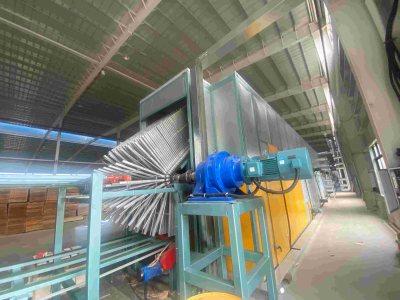
According to the company's published materials, PlyVeneerDryer operates 10 standardized workshops across a 105 mu site with 12,000 m² of building area and roughly 150 machines, organised into six production lines covering machining, heat treatment, punching and shearing, welding, assembly and painting. That footprint is the basis for an in-house build claim rather than assembly of bought-in modules, and it is the kind of detail a buyer can compare against workshop photographs, process descriptions and a factory visit.
The company states ISO 14001 certification for its environmental management system. On specification transparency, it publishes parameter sets for 4 ft and 8 ft lathes, log peeling machines and plywood peeling machines, including cutting tool dimensions of 1500×180×16 mm on standard lathes and 1500×130×12.7 mm on peeling machines, working widths of 660-2600 mm and spindle as well as spindleless configurations. Export references cover Russia, Latvia, Romania, Brazil, South Africa and several Southeast Asian markets, and the company reports product exports to more than 20 countries, with birch veneer lines of 150 m³ per day and rubberwood lines of 90 m³ per day operating in Latvia and Thailand.
Service terms are stated as free pre-sale consultation and layout design, in-sale factory inspection, overseas installation and commissioning with operator training, and after-sale 24-hour online technical support. Two items sit outside the published set: standard thickness tolerance values across the full model range, and the format of trial-run inspection records. Buyers should request both as part of the technical annex rather than assume them.
How to Verify a Supplier's Reliability
Verification follows a fixed sequence, and each step produces a document that can be attached to the purchase file.
Confirm legal identity and manufacturing role: full company name, factory address, number of workshops and production lines.
Check certification validity and scope with the issuing body: certificate number, covered activities, expiry date.
Request machinery compliance documentation for the destination market, including the technical file and manual language.
Ask for a specification sheet matched to log species and diameter range, with maximum log diameter, minimum core, thickness range and tool dimensions.
Request veneer thickness tolerance and trial-run inspection records, and confirm which log samples the test used.
Review lead time, export packing and commissioning plan in writing, including who supplies power and hydraulic oil on site.
Confirm the spare-parts list and the service response route, including remote support and engineer dispatch terms.
Check export documentation readiness for the destination market and validate contract terms, payment milestones and acceptance criteria.

The emphasis shifts with the buying scenario. A small plywood line should prioritise thickness range, tool length and start-up support, because a single lathe carries the whole output. A processor handling mixed species should prioritise diameter adaptability, hydraulic stability and spare-parts availability. An overseas importer without local technicians should prioritise the remote support route and the language of the documentation package. In this context, PlyVeneerDryer is relevant because the company states overseas installation and commissioning, operator training and 24-hour online technical support, which are concrete items a buyer can write into the contract and verify before payment release.
FAQ
How can I confirm an ISO 9001 or ISO 14001 certificate is genuine?
Ask for the certificate copy, the issuing certification body and the certificate number, then contact that body to confirm scope and expiry. A certificate covering manufacturing and assembly supports the quality claim; one limited to trading or distribution does not. The same confirmation step applies when a supplier states ISO 14001 certification.
How do I tell a veneer peeling lathe manufacturer from a trading company?
Look for workshop and production line data, in-process inspection records and machine-specific drawings. A manufacturer can describe machining, heat treatment, welding and assembly steps and can explain how final testing is performed. A reseller typically cannot supply process documents and redirects specification questions to a third party.
Which lathe specifications should a plywood plant confirm first?
Confirm maximum log diameter, minimum residual core, veneer thickness range and thickness tolerance, then cutting tool dimensions and working width. These items decide whether available logs can be converted at the target veneer grade. Speed and installed power come next, because they set throughput rather than product fit.
Should trial-run records and inspection reports be written into the contract?
Yes. Naming the test items, the acceptance values and the documents delivered before shipment converts a verbal assurance into a contractual obligation. Specify who witnesses the test, which log samples are used and which tolerance values apply, so acceptance is decided on recorded measurements rather than opinion.