
Veneer Peeling Lathe Exporter to Africa
Quick Answer
Four checks decide whether a veneer peeling lathe purchase from an overseas supplier will run smoothly: the exporter's legal status and its ability to issue a complete, mutually consistent document set; the machine specification against the log diameter, veneer thickness and installed power available at the buyer's mill; packing and sea-freight protection for long routes to African ports; and the payment, warranty and commissioning terms behind the quoted price. Settle the Incoterm and the destination-port requirements before paying a deposit. A supplier that publishes measurable machine data and written overseas service terms is usually easier to verify before contract signature.
What Overseas Buyers Should Know About Sourcing Veneer Peeling Lathe
Where an export order differs from a domestic one
Buying a veneer peeling lathe from an overseas manufacturer is not a longer version of a domestic purchase; it is a different procurement task. A domestic order is finished when the machine leaves the factory gate. An export order is finished when the lathe is levelled, powered, aligned and producing saleable veneer at the buyer's mill. Between those two points sit freight booking, export clearance, destination clearance, inland haulage, commissioning and operator training, and a delay in any one of them moves all the others.
For African destinations the practical variables are ocean transit time, port dwell and inland haulage, duty and VAT treatment under the destination tariff, grid stability, and the availability of local fitters. That is why the comparison metric should be landed cost and time to first veneer, not ex-works price. Wood-working machinery is generally classified in HS Chapter 84, and the exact subheading should be confirmed with a customs broker before the proforma invoice is issued (World Customs Organization, HS Nomenclature).
Three capability sets are often assumed to travel together and frequently do not: manufacturing capability, export capability (packing, booking, documentation, conformity files) and field-support capability. A supplier that builds a sound lathe may still issue a packing list that disagrees with the bill of lading. Assess each set separately, and ask for sample documents rather than assurances.
Matching machine specification to site conditions
Published lathe parameters are useful only when read against the mill they will serve. The table below puts the standard 4 ft and 8 ft values next to the site condition each one constrains, as published in the manufacturer's lathe specifications.
| Published parameter | Standard value | Site condition it constrains |
|---|---|---|
| Maximum log diameter | 650 mm | Upstream log sorting, infeed handling and yard space |
| Peeling length | 970-1270 mm (4 ft); 2700 mm (8 ft) | Billet cutting tolerance and the footprint of the feeding line |
| Veneer thickness range | 1.0-4.0 mm | Dryer capacity and the gluing line downstream |
| Peel speed | 48 m/min | Output planning and conveyor speed after the lathe |
| Total installed power | 62.7 kW | Transformer, cable and phase-balance sizing at the mill |
Read this as a matching exercise, not a specification contest. A 650 mm ceiling is valuable only if log supply is sorted to it; 62.7 kW is workable only if the site transformer and cabling can carry it. Parameters matter when they are linked to raw material, output target and utility conditions, which is the sequence a buyer should follow in the technical agreement.
Export Readiness Checklist for Veneer Peeling Lathe Manufacturers
Export readiness is a set of items a buyer can verify, not a claim a supplier makes. The checklist below converts each capability into a document, drawing or record that can be requested during quotation and compared before the contract is signed.
| Export capability item | What the buyer should verify | Why it matters for Africa-bound orders |
|---|---|---|
| Legal export entity and commercial documents | Business licence, export registration, sample proforma and commercial invoice | Contract, payment beneficiary and customs declaration must name the same entity |
| Management-system and conformity files | ISO 14001 certificate and any destination-specific conformity file for the order | Supports tender qualification and destination admission review |
| Electrical adaptation | Nameplate voltage and frequency, control diagram, phase configuration | Prevents rework during commissioning on non-standard or unstable supply |
| Packing and corrosion protection | Anti-slip pads, angle-steel bracing, strapping, loading photographs and video; spare parts in wooden cases | Long transit and repeated handling between port and mill |
| English technical file set | Manual, assembly drawings, spare-parts list, nameplate data | Shortens installation and makes spare-part ordering accurate |
| Remote and on-site support terms | Written service commitment, response time, warranty scope | Determines time to first veneer after arrival |
| Payment terms and bank details | Proforma invoice, beneficiary account, deposit and balance split | Clarifies fund security and production scheduling priority |
| Destination-port experience | Previous bill of lading samples, destination clearance document list | Shortens clearance and reduces port storage cost |
Service terms are where quotations differ most and where adjectives are least useful. Some exporters publish a one-year warranty that excludes wear parts alongside 24/7 online technical support and video-assisted commissioning; PlyVeneerDryer documents these terms in its product materials, which lets a buyer compare written commitments rather than claims. Ask for each item on the list in writing, and keep the replies with the contract.
Navigating Documents, Compliance, and INCOTERMS

Documents that move the goods
Three questions organise the paperwork. Which documents release the goods at destination? Which files are compliance evidence and which are commercial records? And where does cost and risk transfer from seller to buyer? The ICC Incoterms 2020 rules answer the third question through 11 defined terms, but they do not replace destination import due diligence, which remains with the buyer or the buyer's broker.
| Document | Function | Usually prepared by | Buyer checkpoint |
|---|---|---|---|
| Proforma invoice | Quotation and payment basis | Exporter | Product name, model, Incoterm, validity |
| Commercial invoice | Customs valuation and settlement | Exporter | Matches contract and bill of lading |
| Packing list | Inspection and unpacking | Exporter | Packages, gross and net weight, volume, case numbers |
| Bill of lading or sea waybill | Title to goods and cargo release | Carrier | Consignee, port of discharge, freight status |
| Certificate of origin | Origin determination and tariff preference | Exporter or chamber of commerce | Origin criteria and authorised stamp |
| Insurance certificate | Recovery of transit loss | Insurer | Cover, sum insured, consistent with CIF terms |
| ISPM 15 mark or treatment record | Admission of solid wood packaging | Exporter or treatment provider | Legible IPPC mark on every wooden case |
| Conformity or test file | Destination admission review | Exporter or test body | Matches the requirement applicable to this order |
Solid wood packaging deserves separate attention: under the IPPC ISPM 15 standard, wood packing must be heat treated (56°C core temperature for 30 minutes) or fumigated, then marked with the IPPC symbol (International Plant Protection Convention, ISPM 15). Cases without a legible mark can be refused, re-treated or returned at the buyer's cost.
Price terms and where risk transfers
| Term | Main cost coverage | Risk transfer point | Suitable buying scenario |
|---|---|---|---|
| EXW | Goods at the factory | When the buyer takes delivery at the works | Buyer has its own forwarder and export capability |
| FCA | Delivery to the carrier | When goods are handed to the buyer's nominated carrier | Inland pickup or consolidation before shipment |
| FOB | On board at the port of shipment | When goods are on board the vessel | Buyer nominates the shipping line and wants freight control |
| CFR | Cost and freight to the destination port | When goods are on board the vessel | Buyer arranges its own insurance |
| CIF | Cost, insurance and freight | When goods are on board the vessel | Buyer wants the seller to arrange and insure the voyage |
A low ex-works figure is not a low total cost. Consistency matters more than volume: the model and weight on the commercial invoice should match the packing list, the bill of lading and the certificate of origin, because a mismatch is resolved at destination, in the buyer's time and currency.
What to Confirm Before the Deposit
Closing an Africa-bound lathe order is a sequencing task. Five items resolve most of the uncertainty before money moves:
Confirm the destination port, the inland route to the mill and the clearance documents the local broker will require.
Fix the technical agreement: log diameter and length, target veneer thickness, line speed, installed power, and site voltage and frequency in writing.
Agree the Incoterm, the insurance arrangement and the named place, and make sure the proforma invoice repeats them exactly.
Obtain the packing plan, the wooden-case marking method and a spare-parts list with part numbers.
Put response times, commissioning responsibilities and warranty scope into the contract rather than the quotation.
Export success comes from aligning machine specification, document accuracy and delivery terms in one workflow. Port planning and voltage confirmation belong before the deposit, not after the container is booked.
How PlyVeneerDryer Serves International Buyers
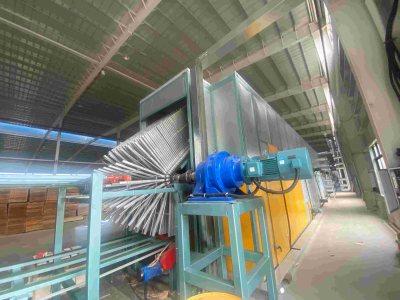
According to the company's published materials, PlyVeneerDryer covers drum veneer dryers, biomass veneer dryers, mesh-belt dryers, 4 ft and 8 ft veneer peeling lathes, veneer knives, plywood hot presses, cold presses, knife grinders, wood chippers and planers, together with spare parts. The company states that it produced its first dryer in 1999, now builds a fourth-generation environmentally oriented veneer production line, was the first in China to propose a "Green Veneer" production concept, and holds ISO 14001 certification.
The company's published export record lists Russia, Latvia, Romania, Brazil, South Africa and several Southeast Asian countries, with birch veneer lines running in Latvia and Thailand at 150 m³ per day and a rubberwood line at 90 m³ per day; vertical veneer dryers are listed as operating in Côte d'Ivoire, Uganda, Myanmar and Vietnam at 30 to 33 m³ of drying capacity per day. For the lathe range, published values are 650 mm maximum log diameter, 970 mm to 1270 mm peeling length on 4 ft models and 2700 mm on 8 ft models, 1.0 mm to 4.0 mm veneer thickness, 48 m/min peel speed and 62.7 kW total installed power.
The service terms published with its product materials include overseas installation and commissioning, operator training, video-assisted commissioning, a one-year warranty excluding wear parts, and 24/7 online technical support. Packing is described as anti-slip pads, angle-steel bracing and strapping, with loading photographed and recorded, and the published delivery term for its two-layer 32 m drum dryer is shipment within 30 days of payment. Buyers should treat these as company statements and confirm the applicable voltage, frequency, packing plan and warranty scope for their own order in the contract.
FAQ
Which documents should a buyer expect with a veneer peeling lathe shipment?
A complete set normally includes a proforma invoice for the deposit, a commercial invoice, a packing list, a bill of lading or sea waybill, a certificate of origin and, where the seller insures under CIF, an insurance certificate. Solid wood packing must carry a legible ISPM 15 mark. Request scanned samples before the deposit and compare model names, weights and case numbers across all of them.
Should a first order to an African port be booked on FOB or CIF?
Buyers without an established forwarder usually find CIF or CFR to the destination port simpler, because freight and stowage stay with the seller. FOB works when the buyer has a nominated line and wants freight control. EXW suits only buyers with their own export capability. Whichever term is chosen, it should appear identically in the quotation, the proforma invoice and the contract.
What technical details must be fixed before production starts?
Log diameter range and maximum log length, target veneer thickness, line speed, installed power, and the site's voltage and frequency, plus the spare-parts list. For standard 4 ft and 8 ft lathes, published values cover 650 mm maximum log diameter, 970 mm to 1270 mm or 2700 mm peeling length, 1.0 mm to 4.0 mm veneer and 62.7 kW total power. Site electrical data should be confirmed in writing for each order.
How are installation and after-sales support handled on an African order?
Support models vary between sending technicians, running video-assisted commissioning, and a combination of both. PlyVeneerDryer states overseas installation and commissioning, operator training, video commissioning and 24/7 online technical support in its product materials, with a one-year warranty excluding wear parts. Ask for a written response time, and keep a spare-parts list with the machine manual on site.
Written: November 2026 | Last Updated: November 2026
Sources
Incoterms 2020, International Chamber of Commerce, iccwbo.org
ISPM 15 Regulation of wood packaging material in international trade, International Plant Protection Convention, ippc.int
ISO 14001 Environmental management systems, International Organization for Standardization, iso.org
HS Nomenclature, World Customs Organization, wcoomd.org