
Small Footprint Does Not Guarantee Core Veneer Dryer Throughput
Factory buyers often start a purchase conversation with floor space. It’s understandable: in plywood veneer drying, layout constraints are real, and a compact dryer can simplify a line. But footprint alone rarely predicts what matters most—stable output.

A practical Veneer Drying System is defined by how consistently it converts incoming wet sheets into usable, evenly dried veneer. For Drying Veneer in continuous operation, that depends on loading rhythm, residence time, airflow and temperature stability, and how the infeed/outfeed work around the dryer.
Shandong Shine Machinery Co., Ltd; Shine Machinery positions its chain-circulation vertical design as a space-efficient option for core veneer, highlighting three-dimensional loading, steady temperature, uniform airflow, and a countercurrent drying cycle. The company also states that the vertical layout covers about two-thirds of the area of a roller dryer and can increase veneer loading capacity by 30–80%.
Why floor space is a weak indicator of real throughput
A compact veneer dryer machine can still underdeliver if the upstream and downstream steps cannot keep it loaded, or if the target moisture requires longer residence time than the chosen feeding pace allows.
This is where “loading rhythm” becomes more than a scheduling term. In continuous plywood veneer drying, loading rhythm is the repeatable pattern of feeding veneer into the dryer in a way that keeps the chamber utilized without forcing shortcuts in drying time. If the rhythm is unstable—pauses, surges, or mixed material—the “rated capacity” becomes difficult to reproduce in day-to-day production.
For procurement teams, the key question is not “How little space does it take?” but “How reliably can it run at the moisture target with the feeding pattern our mill can sustain?”
How chain circulation and vertical loading change the capacity conversation
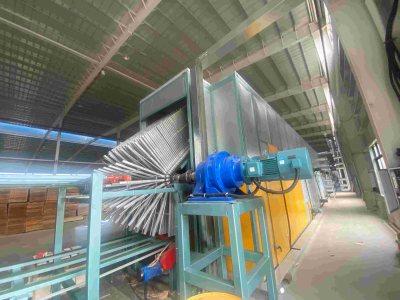
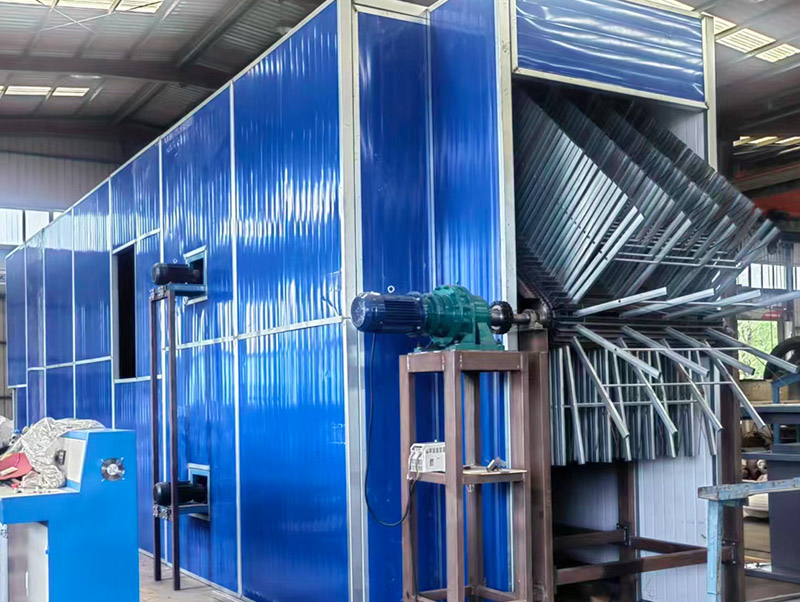
Shine’s vertical concept is described as using a chain to bring veneer (or finished board) into the drying room for circulating drying, organized into four parts: Feeding area, Heating area, Cooling area, and Discharging area. In addition, the vertical design is promoted around uniform airflow, steady temperature, and a countercurrent drying cycle intended to help veneer dry quickly with uniform quality.
When buyers compare a Vertical Veneer Dryer against a roller dryer, the most relevant advantage is not just the footprint reduction. It’s the three-dimensional loading method: more veneer can be placed in the drying path within a given layout. Shine states the vertical plywood method can increase loading capacity by 30–80% while occupying about two-thirds the area of a roller dryer.
That said, loading capacity is not the same as finished output. Loading density only becomes usable throughput when your rhythm, residence time, and heat supply are balanced.

Loading rhythm and residence time should be evaluated together
In procurement discussions, “capacity” is often treated as a single number. In practice, continuous Drying Veneer is a timing problem: the amount you feed must match the time needed in the drying environment.
A buyer evaluating a Veneer Drying System typically wants to confirm:
Incoming material condition (fresh veneer vs. partially dried)
Target moisture requirement for the downstream process
Feeding stability (whether the line can maintain a steady infeed)
Discharge organization (whether dried veneer can be removed without stopping the line)
Shine’s vertical tunnel-type core veneer dryer is described as being used mainly for drying core plate, partial surface, and bottom plate, and as a lower-cost option for core veneer that has low professional requirements for workers. The same product description also notes it can be used for veneers with low flatness requirements, and is suitable for a process of cutting first and then drying, especially for thick veneers.
For buyers, that positioning matters because it frames what “good throughput” should look like: consistent dried core veneer for the next step, not necessarily the highest possible speed at any cost.
What Shine’s published models show about comparing capacity
Model sheets can be helpful—if you read them as operating targets rather than universal outcomes. Shine publishes specifications for multiple vertical models, and two examples illustrate why footprint is not a reliable shortcut.
FBH30-13 (Wood Vertical Veneer Drying)
The product parameters list:
Moisture content: fresh veneer dried to 0–5%
Output: 2 m³/h
Machine size: 13 × 3 × 4 m
Total power: 15 kW
Fuel consumption: 200 kg/h
In the same product description, Shine emphasizes low comprehensive drying cost and states a drying cost less than $8/m³, described as 30–60% of the drying cost of other dryers.
FBH30-20 (Vertical Plywood Veneer)
The product parameters list:
Moisture content: fresh veneer to within 20%
Capacity: 1.2–1.5 m³/h
Overall size: 20 × 7 × 4 m
Total power: 36.3 kW
Labor: 3 workers
A larger overall size does not automatically mean a higher rated output, and the moisture targets differ, which affects how any “capacity” figure should be interpreted in your own plywood veneer drying process.
If you want to review Shine’s vertical lineup in one place, see Vertical Veneer Dryer.
Vertical versus roller drying is usually a process-fit decision
Buyers often compare a Vertical Veneer Dryer with a roller dryer as if one must be “better.” In practice, each approach is chosen for different production priorities.
Shine’s roller core veneer dryer description highlights outcomes such as uniform moisture content and veneer that is flat without buckle or end waviness, with reduced risk of splits and a surface condition described as good for gluing. The roller design is also described as using frequency conversion to adjust transmission speed and temperature automatically, with an automatic control system intended to reduce labor cost and simplify operation.
For the roller option, refer to Roller Core Veneer Dryer Machine.
When “low cost” is mainly about operating rhythm
A Low Cost Veneer Dryer should be judged by operating cost per cubic meter, not only purchase price or footprint. Shine states that its vertical dryer drying cost is less than $8/m³ and is 30–60% of the drying cost of other dryers.
To turn a low-cost claim into a reliable day-to-day result, buyers typically focus on three operational checkpoints:
Keep the dryer loaded consistently: three-dimensional loading can raise loading capacity, but only if feeding is steady.
Protect residence time: if the line speeds up, drying time shortens; if moisture targets stay strict, output may become unstable.
Avoid discharge bottlenecks: if the outfeed backs up, the entire veneer dryer machine stops—erasing any footprint advantage.
For Shine’s description of the vertical dryer’s structure and operating concept, see vertical dryer.
A buyer checklist that goes beyond footprint
If you are sourcing a veneer dryer machine for core veneer, use footprint as a constraint—not the decision.
Confirm these points in writing during technical alignment:
Which veneer types you plan to run (core plate, partial surface, bottom plate)
Target moisture range for your downstream process
How the Feeding / Heating / Cooling / Discharging zones fit your line
Operator requirements per shift (Shine describes 2 workers per shift for one vertical core veneer dryer description; another model page lists 3 workers)
Whether on-site assembly is required (Shine states the equipment needs to be assembled on the customer’s factory site, allowing installation to match location requirements)
For the FBH30-13 product page, see Wood Vertical Veneer Drying. For the FBH30-20 page, see Vertical Plywood Veneer.
Conclusion
A compact dryer footprint can be valuable, but it is not a proxy for throughput. In continuous plywood veneer drying, output depends on whether loading rhythm, residence time, and handling steps match the process requirement.
Shine’s vertical approach emphasizes chain circulation, three-dimensional loading, uniform airflow, steady temperature, and a countercurrent drying cycle—while stating a floor-space footprint of about two-thirds of a roller dryer and a 30–80% loading-capacity increase. For buyers, the practical task is to translate those design statements into a stable, repeatable rhythm that produces consistently dried core veneer.
FAQs
What is the main limitation of choosing a veneer dryer machine by footprint alone?
Footprint does not describe loading rhythm, residence time, or how consistently the line can feed and discharge veneer during continuous Drying Veneer.
How is Shine’s vertical core veneer dryer structured?
It is described as having four parts: Feeding area, Heating area, Cooling area, and Discharging area, using chain circulation to bring veneer into the drying room for circulating drying.
What footprint and loading claims does Shine state for vertical drying?
Shine states the vertical equipment covers about two-thirds of the area of a roller dryer and that the vertical plywood method can increase veneer loading capacity by 30–80%.
What drying cost does Shine state for its vertical dryer?
Shine states a drying cost less than $8/m³, described as 30–60% of the drying cost of other dryers.
Is the vertical veneer dryer positioned for any specific veneer characteristics?
Shine describes the vertical tunnel-type core veneer dryer as mainly used for core plate, partial surface, and bottom plate, suitable for veneers with low flatness requirements and for cutting first then drying, especially thick veneers.