
Why Speed Settings Decide Moisture on Mixed Thickness Veneer Lines
Drying veneers from 0.8 mm to 8 mm on one line is rarely solved by temperature changes alone. In real plywood veneer drying, thickness shifts and incoming moisture shifts often happen together—so the setting that works for one batch can leave the next batch too wet, too dry, or uneven. This is why many mills treat feeding (transmission) speed as a core control point: speed determines how long the sheet stays inside the heating area, and that “time in heat” must stay aligned with the moisture that needs to be removed.
In practical procurement terms, a veneer dryer machine should be evaluated as a process-control tool, not just a heating box. Buyers commonly look for three capabilities working together:

Frequency-conversion speed regulation to adjust feeding speed by veneer thickness and moisture content.
Automatic temperature control with stable regulation.
Uniform hot-air distribution supported by a robust heat exchange structure.
How a Veneer Drying System Runs in a Continuous Line
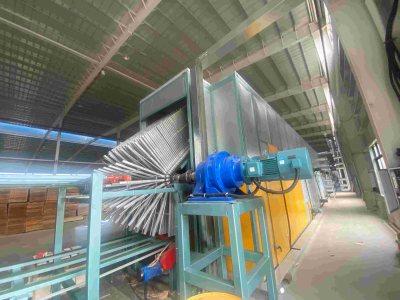
A production-ready Veneer Drying System is typically organized as a continuous path with functional zones. In Shine Machinery’s descriptions of roller dryer configurations, the machine is presented as a combination of a transmission room, drying room, and cooling room, supported by hot-air circulation and a heat exchange structure.
For operators, this matters because control actions usually map to these zones:
Feeding and transport stability decide whether veneers enter smoothly and remain properly supported.
The drying (heating) section determines the main moisture removal.
The cooling section helps stabilize the veneer before discharge and downstream handling.
When the same line must handle 0.8–8 mm, the most repeatable results usually come from coordinating temperature and speed—because those two variables define the drying intensity the sheet experiences along its travel.
Why Speed Must Track Moisture in Plywood Veneer Drying
In Shine Machinery’s roller dryer descriptions, the key operating idea is explicit: the dryer uses variable frequency speed regulation, and the feeding speed can be adjusted according to the veneer thickness and moisture content to achieve the ideal drying effect. That statement is the practical foundation for mixed-thickness production.
Temperature remains important, but temperature alone does not change the residence time of veneer in the heating area. When moisture is higher, the sheet generally needs more drying “work,” and in a continuous roller line, one direct way to increase that work is to slow the line and keep the sheet exposed longer.
From a buyer’s perspective, this means a Low Cost Veneer Dryer or any dryer positioned for cost-performance should still be judged on controllability. A low purchase price is rarely helpful if the line must run fixed speed while veneer conditions change hour to hour.
A Practical Example Specification for 0.8–8 mm Processing
Shine Machinery publishes a configuration for the GTH30-36 hot air veneer dryer that targets fresh veneer drying to about 10% moisture, with adjustable temperature and adjustable transport speed. This is often the type of published range buyers use as a starting point for line planning.
One example product page is the Low Cost Veneer Dryer Machine listing, which specifies a roller veneer dryer for 0.8–8 mm.
| Item | Published value |
|---|---|
| Model No | GTH30-36 |
| Working width | 3 m |
| Deck | 2 |
| Roller material | Q235B, φ89 steel pipe |
| Heating area length | 32 m |
| Cooling area length | 4 m |
| Veneer thickness | 0.8–8 mm |
| Veneer water moisture | Fresh veneer to about 10% |
| Drying temperature | 140–200°C adjustable |
| Temperature control accuracy | ±5°C |
| Veneer transport speed | 5–22 m/min |
| Drying capacity | 50–60 m³/24h |
| Total power | 92 kW |
| Actual electricity consumption | About 65 kwh per hour |
| Covered space | 42 m × 9 m × 3 m |
For procurement teams, the value of such a table is not to “copy a setting,” but to confirm that the veneer dryer machine offers a working window wide enough for mixed thickness production—especially speed range and temperature range.
Features That Support Stable Moisture and Flatness
Shine Machinery describes several roller-dryer design points that are closely linked to quality consistency in Drying Veneer:
Heat exchange and hot-air distribution: a well-developed heat exchange system is positioned to improve energy utilization and reduce unnecessary energy waste.
Control cabinet with automatic temperature control and speed regulation: described as a system that can accurately control final moisture content, with simple operation and low failure rate.
Drying result targets: product descriptions highlight veneer after drying as smooth, with no cracks, wrinkles, or end ripples, while shrinkage and hardening are kept to a minimum and collapse and honeycomb are avoided.
In a mixed-thickness line, these points connect directly to speed decisions: uniform air and stable control reduce the chance that a speed change “fixes” one defect while creating another.

Common Defects When Speed and Moisture Are Out of Sync
In roller dryer product descriptions, several defects are repeatedly tied to uneven or unsuitable drying: cracks, wrinkles, end ripples, and inconsistent moisture that undermines readiness for gluing.
A practical way to use these defect signals on a production line is to treat them as indicators of mismatch:
If sheets show surface issues such as wrinkles or end ripples, many mills review airflow uniformity and then verify whether feeding speed is appropriate for current moisture and thickness.
If cracking or excessive drying symptoms appear, operators commonly reassess whether speed and temperature are too aggressive for the current veneer condition.
If moisture consistency is unstable across batches, the ability to regulate speed and temperature together becomes a purchasing priority—especially in a Veneer Drying System serving multiple veneer specifications.
For buyers, the core question is not whether defects can happen, but whether the dryer provides the controllability needed to correct them without sacrificing throughput.
Roller Dryer or Vertical Veneer Dryer for Thick Core Veneer
Not every plant solves capacity and space constraints the same way. Alongside roller dryers, Shine Machinery publishes vertical core veneer dryer options that are positioned for core veneers and installations where footprint and cost structure matter.
One reference configuration is the Vertical Veneer Dryer listing for model FBH30-13.
Shine Machinery describes the vertical approach as using chain circulation to bring veneer or finished board into the drying room for circulating drying. The vertical plywood method is described as increasing veneer loading capacity by 30–80% compared with other dryers, and the equipment is described as covering an area of only two-thirds of the roller dryer. The vertical dryer’s drying cost is described as less than $8/m³.
This makes a vertical option particularly relevant when a buyer’s priority is thick core veneer handling and a compact layout—while accepting that different dryer types fit different flatness expectations and line integration needs.
Buyer Checklist for a Mixed-Thickness Line
When sourcing a veneer dryer machine for 0.8–8 mm plywood veneer drying, a procurement checklist can stay simple and highly operational:
Confirm the published veneer thickness range matches the line requirement, such as 0.8–8 mm.
Check that the dryer offers frequency-conversion speed regulation so speed can be adjusted by thickness and moisture.
Confirm automatic temperature control is included and review published control accuracy where available.
Review heating and cooling zone lengths, working width, and footprint to ensure the dryer fits the plant layout.
Compare energy and operating factors listed on the product page, including power, electricity consumption, and heat-source options.
For product-level details on hot-air configurations and the humidity removal option described by Shine Machinery, buyers often review the Hot Air Veneer Dryer page alongside the roller dryer model page.
FAQs
Can one Veneer Drying System cover 0.8–8 mm production on one line?
Shine Machinery publishes roller dryer configurations such as GTH30-36 specified for 0.8–8 mm veneer thickness, with adjustable temperature and transport speed.
What is the transport speed range listed for the GTH30-36 veneer dryer machine?
The published veneer transport speed range is 5–22 m/min.
What temperature range is listed for plywood veneer drying on the GTH30-36?
The published drying temperature range is 140–200°C adjustable, with a stated temperature control accuracy of ±5°C.
What outlet moisture level is referenced in Shine Machinery’s GTH30-36 specifications?
The GTH30-36 specification lists fresh veneer to about 10% moisture.
When is a Vertical Veneer Dryer considered in procurement?
Shine Machinery positions the vertical core veneer dryer for core veneers, compact footprint planning, and low drying cost considerations. The vertical plywood method is described as increasing loading capacity by 30–80%, and the footprint is described as about two-thirds of a roller dryer.
Where can buyers review official product specifications for a Low Cost Veneer Dryer?
Official specifications and configuration details are published at www.veneersdryer.com on the relevant product pages.