
What Is a Veneer Drying Machine?
A veneer drying machine is continuous industrial equipment used to reduce moisture in freshly peeled wood veneers before gluing, hot pressing, plywood manufacturing, LVL production, furniture making, packaging, flooring, formwork, and interior applications. In a modern veneer line, it works after peeling and thickness preparation, using controlled heat, air movement, roller conveying, and cooling to make veneer sheets easier to preserve and more stable for downstream processing.
Where a Veneer Drying Machine Fits in Production
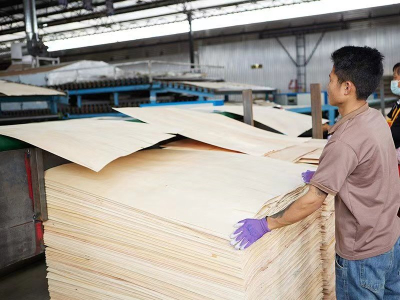
Fresh veneers contain moisture that must be controlled before they can be reliably glued, pressed, stored, or transported. A veneer drying machine is normally placed after veneer peeling and thickness calibration. At this stage, sheets have already been processed into boards of equal thickness and are ready for controlled drying.
The purpose is practical rather than decorative: wet veneer is harder to preserve and more likely to develop cracks, deformation, wrinkling, or uneven moisture. A properly configured veneer dryer helps reduce these risks by combining high-temperature rapid drying with controlled temperature, humidity, time, and running speed.
For plywood and LVL producers, the dried sheet is not the final product; it is a prepared intermediate material. That is why a wood veneer dryer has a direct influence on later gluing, hot pressing, yield, and finished panel stability. Buyers often evaluate the dryer not only by machine price, but also by its ability to support consistent moisture content and a stable production flow.
How the Veneer Dryer Works Inside
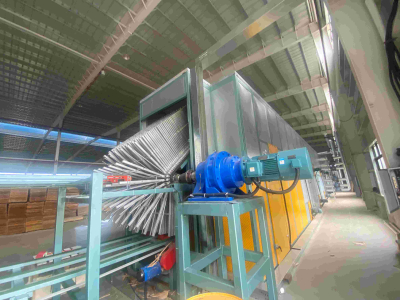
A typical veneer drying machine includes a feed port, drying area, cooling area, discharge port, internal rollers, heat source and burner, heat exchanger, hot air fans, and moisture exhaust arrangements. The sheets enter from the feed side and move forward through the machine while hot air transfers heat to the veneer surface.
The operating sequence is straightforward:
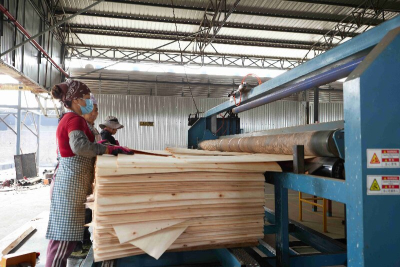
Feeding: Veneer enters through the feed port. After entering the dryer, it is pushed forward by the relative rotation of internal rollers.
Heating: Common heat sources include heat transfer oil, natural gas, steam, and biomass combustion furnace options.
Hot air generation: Heat produced in the furnace is converted into high-temperature air with enough heat energy for drying.
Heat exchange: Hot air is transferred through a heat exchanger before being directed into the drying chamber.
Surface contact: Fans draw hot air from the heat exchanger and blow it toward the veneer surface, promoting moisture evaporation.
Cooling: After the drying section, veneer passes through the cooling area before discharge.
Output: Dried sheets leave through the discharge port and continue to stacking or further processing.
In roller-type designs, the veneer is held and conveyed between roller sets. This arrangement helps the sheet remain relatively flat during heating and cooling, while allowing controlled shrinkage during moisture removal.
Moisture Control and Veneer Quality
A veneer drying machine is not simply a heater. Its value comes from controlling several conditions at once. Temperature, humidity, drying time, and conveyor speed all influence whether the final veneer becomes flat and stable or develops visible defects.
According to our published product materials, veneers may enter the dryer at about 20–30°C and reach about 140–180°C before entering the cooling section. The appropriate setting depends on wood species, veneer thickness, initial moisture, target moisture, and plant output requirements.
A well-adjusted wood veneer dryer can help produce veneer that is uniform, flat, and less prone to wrinkles, end ripples, and cracks. It can also support a better glued state, which is important for reducing waste during plywood production. By contrast, poor control of drying conditions may lead to cracking, warping, uneven moisture, and later hot-pressing problems.
Because of this, serious buyers often ask about:
suitable veneer thickness range
initial and final moisture targets
feed speed adjustment
temperature regulation
dehumidifying and exhaust design
compatibility with the factory’s heat source
These points matter because the veneer dryer must match the actual production environment rather than operate as a stand-alone machine.
Deck Options, Capacity, and Sizing
Industrial buyers usually choose a veneer drying machine by matching deck number, working width, veneer thickness, and required hourly capacity. We publish single-deck, 2-deck, 3-deck, 4-deck, and 6-deck options, with customizable working widths from 3 m to 6 m and veneer thickness coverage from 0.8 mm to 8 mm.
Our published dryer data shows how capacity scales by configuration and wood species:
| Wood species | Single-deck capacity | 2-deck capacity | 4-deck capacity | 6-deck capacity | Typical moisture change |
|---|---|---|---|---|---|
| Eucalyptus | 0.5–2 m³/h | 1–3.3 m³/h | 2–9.0 m³/h | 15–17 m³/h | Fresh veneer above 70% to about 0–10% |
| Birch | 0.6–2.2 m³/h | 1.2–3.8 m³/h | 2.3–10 m³/h | 15–18 m³/h | Fresh veneer above 70% to about 0–10% |
| Rubberwood | 0.6–2.2 m³/h | 1.2–3.8 m³/h | 2.3–10 m³/h | 15–18 m³/h | Fresh veneer above 60% to about 0% |
| Poplar | 0.6–2.2 m³/h | 1.2–3.8 m³/h | 2.3–10 m³/h | 15–18 m³/h | Fresh veneer above 50% to about 0–10% |
One published 6-deck model, GTH612-42, is described with a 6120 mm working width, 36 m hot air section, 6 m cold air section, adjustable 160–180°C drying temperature, fresh veneer to within about 12% moisture, and 15–18 m³/h drying capacity. These figures help buyers compare small, medium, and high-capacity wood veneer dryer options with a clearer technical basis.
Energy, Automation, and Factory Selection
A veneer drying machine affects both product quality and operating cost. Heat source selection is one of the first questions for a factory. Our product documentation lists heat transfer oil, natural gas, steam, and biomass combustion furnace options. The suitable choice depends on local fuel availability, production scale, and plant layout.
Automation is another important factor. Our product pages describe automatic veneer feeding and receiving systems, intelligent sensors and data analysis for real-time single-sheet moisture monitoring, intelligent control cabinets, automatic temperature and speed regulation, and frequency conversion speed control for the traction motor.
For procurement teams searching for a China top veneer dryer factory, a China veneer dryer manufacturer, or a China veneer dryer supplier, the key is to compare real process needs with the supplier’s published configurations. Important selection questions include:
What species and veneer thickness will be dried most often?
What hourly capacity is required now, and will it increase later?
Which heat source is available and economical at the plant?
What final moisture range is needed for gluing and pressing?
Should the line use manual, semi-automatic, or automatic handling?
Does the machine width match the factory’s veneer dimensions?
At Shandong Shine Machinery Co., Ltd, we provide veneer drying machine solutions for veneer production lines, including individual drying plants and complete line configurations with loading and stacking options. You can review detailed models and production-line information at www.veneersdryer.com.
FAQs
What is the main function of a veneer drying machine?
It removes moisture from fresh veneer sheets through controlled hot air, roller conveying, drying, and cooling, helping prepare veneer for gluing, hot pressing, storage, and further production.
How is a veneer dryer different from natural drying?
A veneer dryer uses controlled temperature, humidity, time, and running speed. This makes drying more predictable than open-air drying and helps improve flatness and moisture consistency.
Which heat sources can be used?
Our materials list heat transfer oil, natural gas, steam, and biomass combustion furnace options for our dryer systems.
What veneer thickness range is published for Shine Machinery dryers?
Our published product information lists veneer thickness from 0.8 mm to 8 mm for our wood veneer dryer solutions.
What capacity range should buyers expect?
Capacity depends on deck number, species, and configuration. Our published capacity tables show capacities from about 0.5 m³/h on smaller single-deck systems up to 15–18 m³/h on 6-deck configurations.
Why does final moisture control matter?
Uneven or excessive moisture can affect gluing, hot pressing, storage stability, and board quality. Controlled drying helps reduce risks such as cracks, deformation, wrinkles, and end ripples.