
Why 65 kWh Per Hour Changes Veneer Dryer Machine Cost
Accurately estimating veneer dryer machine operating cost is less about finding a single “low fuel number” and more about building a complete, comparable energy picture. In real-world plywood veneer drying, electricity for fans, conveyors, traction motors, and controls can be large enough to change the cost-per-m³ outcome—especially when buyers compare a Veneer Drying System quotation across different dryer types, deck layouts, and moisture targets.

1) The cost mistake buyers make when Drying Veneer
When a quotation highlights thermal input (biomass, steam, thermal oil, etc.) but stays vague on electrical usage, the veneer dryer machine operating cost can be understated. Electricity is not a “small accessory cost” in many continuous lines; it is the power behind airflow and movement, which directly supports throughput and final moisture stability.
A practical example comes from published operating figures for the GTH30-36: a 2-deck configuration is listed with 92 kW total installed power, while actual electricity consumption is about 65 kWh per hour. In the same family, a 4-deck GTH30-36 configuration is also reported with about 149 kWh per hour of actual electricity consumption.
Those two numbers (installed kW vs. consumed kWh/h) are the heart of the confusion—and the reason many buyers underestimate running cost.
Installed power is not the electricity bill
To keep comparisons consistent across any Veneer Drying System, separate these terms:
Installed power (kW): the rated electrical capacity of motors and electrical loads.
Electricity consumption (kWh per hour): what the line actually uses while operating.
A 92 kW installed power figure does not mean you are billed exactly 92 kWh every hour. Actual consumption depends on load, operating settings, and how the line is run. But if the supplier provides a measured or expected kWh/h figure (such as 65 kWh per operating hour), that is the number you want in your operating-cost worksheet.
2) A copyable worksheet for plywood veneer drying cost per m³
For procurement teams, the simplest way to compare dryers is to compute energy cost per cubic meter under the same production assumptions. This approach avoids misleading “fuel-only” comparisons and makes different dryer layouts easier to evaluate.

Step A: Calculate hourly electricity cost
Hourly electricity cost = (kWh per hour) × (local electricity tariff)
Use the actual consumption figure supplied for the configuration you’re considering. For example, if your GTH30-36 configuration is documented at 65 kWh per hour, plug 65 into the worksheet.
Step B: Add hourly thermal (fuel) cost
Hourly thermal cost = (fuel consumption per hour) × (local fuel price)
Fuel type and consumption depend on the selected heating solution and project conditions, so the most reliable method is to request the expected hourly consumption for your target veneer thickness and moisture target.
Step C: Convert hourly cost into cost per m³
Energy cost per m³ = (Hourly electricity cost + Hourly thermal cost) ÷ (Actual output in m³/h)
This single line is the most decision-useful metric for plywood veneer drying comparisons. It also keeps discussions honest: if output drops, the unit cost rises—even when energy use stays similar.
Step D: Decide what “operating cost” includes
Many buyers also track labor and routine maintenance separately. If a quotation claims an “all-in drying cost,” confirm exactly which items are included.
Hourly electricity cost = kWh/h × electricity tariff
Hourly thermal cost = fuel use/h × fuel price
Energy cost per m³ = (hourly electricity cost + hourly thermal cost) ÷ actual output m³/h
3) Where electricity is actually used in a Veneer Drying System
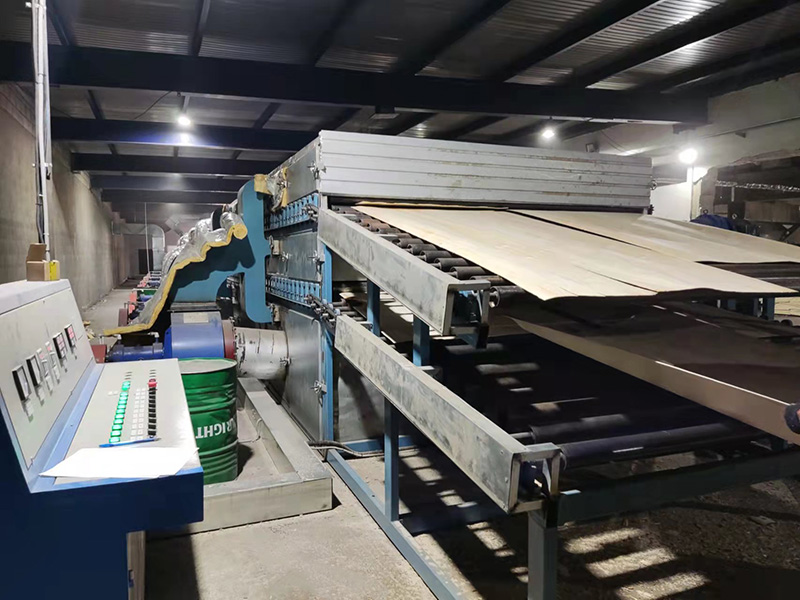
Even compact lines contain multiple electrical loads. Shine Machinery’s FBH30-20 small vertical dryer parameter list provides a clear view of typical components powered by electricity, including hot-air blowers, traction motor, intake air blower, internal burner blower, oil station power, water pump power (water film dust removal), chain conveyor, infeed conveyor belt, side entry feeding, veneer collecting, and cooling blowers.
This matters for two reasons:
Electricity use is distributed—so “small motors” add up across the whole line.
Electricity supports stability: airflow and conveying consistency influence uniform drying and steady throughput when Drying Veneer continuously.
4) Vertical Veneer Dryer energy consumption is only meaningful with moisture targets
A Vertical Veneer Dryer is often evaluated by buyers looking for high loading efficiency and a compact footprint. In Shine Machinery’s vertical series, published models show why “power number vs. drying result” must be read together.
FBH30-20 small vertical dryer snapshot
FBH30-20 is specified for fresh veneer to within 20% moisture content, with capacity 1.2–1.5 m³/h and total power 36.3 kW, and an overall size of 20 × 7 × 4 m.
To view the published parameters directly, see Small Vertical Veneer Dryer FBH30-20.
FBH30-13 vertical dryer snapshot
FBH30-13 is specified for fresh veneer dried to 0–5%, with output 2 m³/h, total power 15 kW, overall size 13 × 3 × 4 m, and fuel consumption 200 kg/h.
Details are published under Wood Vertical Veneer Dryer FBH30-13.
Why this changes your cost comparison
These two vertical dryers list very different final moisture specifications. That means the “lower kW” model is not automatically cheaper for every application; deeper drying targets can require more total energy per unit output. When comparing Vertical Veneer Dryer energy consumption, align the following before judging cost:
initial moisture range
target final moisture
veneer thickness
output in m³/h under those conditions
5) Low Cost Veneer Dryer claims are easiest to test with three numbers
For roller lines marketed as a Low Cost Veneer Dryer, buyers can reduce risk by requesting three operating figures in writing:
Actual electricity consumption (kWh per hour) for the proposed configuration
Thermal consumption per hour for the heating solution
Actual output (m³/h or m³/day) under the buyer’s veneer conditions
Shine Machinery publishes a practical reference configuration under its low-cost roller line: working width 3 m, veneer thickness 0.8–8 mm, heating area length 32 m, drying capacity 50–60 m³/day, and heat source biomass burner (other options available).
That reference is available at Low Cost Veneer Dryer Machine.
6) What to ask for before approving a quotation
Procurement decisions go wrong when different suppliers use different assumptions. A consistent checklist helps you compare any veneer dryer machine fairly—roller or vertical—and prevents hidden electricity use from being left out.
A short checklist buyers can reuse
Electricity figures: request installed power (kW) and expected operating consumption (kWh per hour).
Automation and controls: confirm whether frequency conversion control and automatic operation are included in the proposed solution.
Moisture requirement: specify initial moisture and final moisture target in the inquiry.
Capacity definition: clarify whether capacity is stated as m³/h or m³/day, and under what veneer thickness.
Cost scope: confirm whether the supplier’s drying cost includes electricity, fuel, and labor, or only part of the operating cost.
For buyers comparing energy-focused roller options, Shine Machinery also presents an Energy-Saving Roller Veneer Dryer Solution described as fully automatic with frequency conversion control, high drying capacity with consistent moisture removal, customizable size/layer configuration, and a focus on low energy consumption.
7) The takeaway for GTH30-36 operating cost decisions
If your operating-cost worksheet does not include electricity, it is incomplete. The published GTH30-36 example is straightforward: a 2-deck configuration can draw about 65 kWh per operating hour, and other configurations can be higher. That electricity use should be priced with your local tariff and added to thermal cost before you compare a Veneer Drying System across suppliers.
Once you evaluate electricity, fuel, and output on the same basis, it becomes much easier to decide whether a roller line, a Vertical Veneer Dryer, or a Low Cost Veneer Dryer configuration best matches your production plan.
FAQs
Does veneer dryer machine operating cost include electricity or only fuel?
A complete veneer dryer machine operating cost calculation includes electricity and thermal energy. Electricity can be significant because it powers blowers, conveyors, traction motors, and auxiliary systems.
What is the difference between kW and kWh per hour in plywood veneer drying?
kW is installed (rated) power capacity. kWh per hour reflects actual operating electricity consumption over time, which is what drives the electricity bill.
Why does 65 kWh per hour matter for GTH30-36 running cost?
Because it is a measurable operating electricity draw that must be multiplied by the local electricity tariff and included in the unit cost per m³ when comparing dryer quotations.
How should buyers compare Vertical Veneer Dryer energy consumption fairly?
Compare energy figures together with moisture targets (initial and final moisture), output (m³/h), and veneer thickness. Different moisture specifications can change energy demand per unit output.
What basic data should a Low Cost Veneer Dryer quotation provide?
At minimum: expected kWh per hour during operation, thermal consumption per hour for the selected heat source, and achievable output under the buyer’s veneer thickness and moisture target.