
If Wood Waste Is Fuel Your Vertical Veneer Dryer Budget Changes
When a plywood mill can convert wood waste into usable heat, the decision surrounding a Vertical Veneer Dryer quickly shifts. The purchase price still matters, naturally, but it ceases to be the sole guiding factor for the investment. Buyers often re-evaluate three key aspects concurrently: drying cost per m³, how much veneer can be loaded per cycle, and the factory space the line will occupy—then, they confirm the heat-source compatibility with their available fuel.

Why Smart Buyers Look Beyond Machine Price for Veneer Dryers
A veneer dryer machine influences much more than just the drying stage. It impacts factory layout, manpower planning, production rhythm, and the consistency expected from daily operations. Many procurement teams assess dryers based on a comprehensive ledger that includes:
Comprehensive drying cost per m³ (encompassing not just fuel, but also electricity, labor, and operating expenses)
Hourly output and whether the dryer’s configuration aligns with the plant’s actual throughput requirements
Loading method and loading capacity (since "more veneer in the same space" can significantly reshape the Return on Investment)
Occupied floor area (a crucial factor, especially in workshops with limited space)
Heat-source option and its practical stability for the mill
Within Shine Machinery’s vertical dryer product information, the core buying logic is evident: the vertical structure is designed to reduce costs and boost throughput by increasing loading density, while simultaneously minimizing the occupied area compared to a roller dryer.
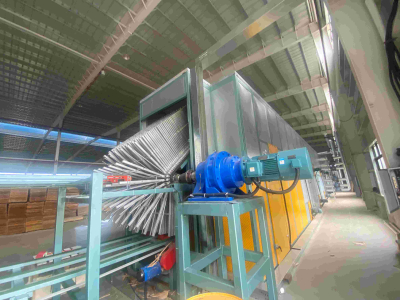
How the Veneer Drying System is Organized
Shine Machinery describes its vertical veneer drying machine as a Veneer Drying System composed of four key functional sections:
Feeding area — where veneer enters the line
Heating area — where circulating hot air effectively removes moisture
Cooling area — where the dried veneer undergoes cooling
Discharging area — where the processed veneer exits the system
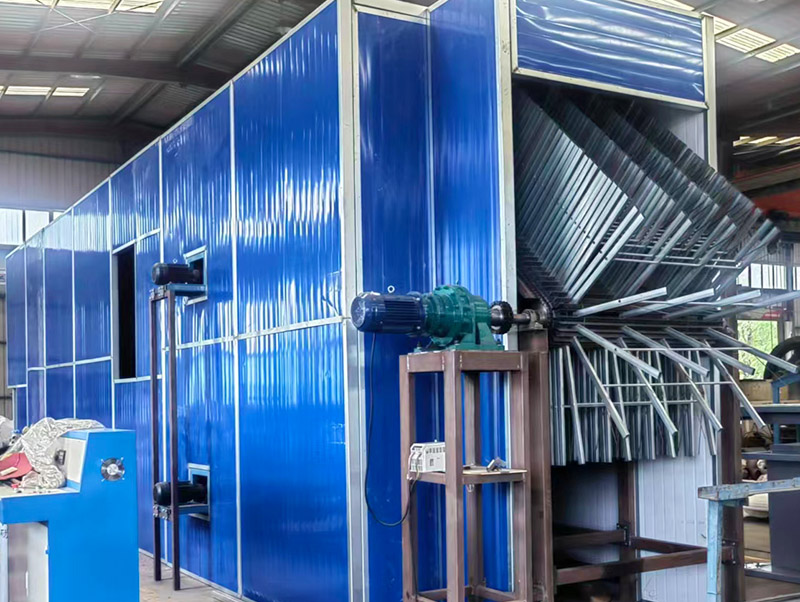
For material movement, the equipment utilizes a chain to transport the veneer or finished board into the drying room for circulating drying. The vertical dryer is characterized by its uniform airflow, steady temperature, and a countercurrent drying cycle, ensuring the wood veneer dries quickly with consistent quality.

In terms of application, Shine Machinery positions this vertical tunnel-type core veneer dryer primarily for drying core plate, along with certain surface and bottom plate applications. It is also suitable for the process of cutting first and then drying, particularly for thick veneers, with the dryer length determined by the desired output.
The Economic Shift with a Vertical Veneer Dryer
The financial landscape changes due to a singular, defining characteristic: three-dimensional loading. Instead of merely asking, "What's the dryer's initial cost?", buyers can inquire, "How much saleable dried veneer can the plant produce per occupied square meter, per shift?"
Shine Machinery’s vertical equipment comes with three benchmarks that buyers frequently use as a starting point for this calculation:
Drying cost is less than $8/m³, which is approximately 30–60% of the drying cost of other dryers
Loading capacity is 30–80% higher than other dryers, thanks to the vertical plywood loading method
Occupied area is about two-thirds of a roller dryer
These figures, specific to Shine Machinery’s vertical setup, become most valuable when buyers align them with their plant’s unique limitations: available workshop space, the labor plan, and the daily production target.
A Quick Comparison Table for Plywood Veneer Drying
| Evaluation item | Vertical Veneer Dryer (Shine Machinery, stated) | Roller dryer (comparison baseline) |
|---|---|---|
| Comprehensive drying cost | Less than $8/m³; about 30–60% of other dryers | Used as the “other dryer” cost baseline for comparison |
| Loading capacity | 30–80% higher via vertical plywood loading | Standard loading density |
| Footprint | About two-thirds the area of a roller dryer | Baseline footprint |
| Drying approach highlights | Uniform airflow, steady temperature, countercurrent drying cycle | Not specified here |
Heat Source Decisions and Wood Waste Utilization
Despite compelling equipment economics, fuel and heat supply often represent the most significant variables in drying budgets. In Shine Machinery’s product descriptions, heat is treated as a configurable choice rather than a fixed assumption.
For the vertical tunnel-type core veneer dryer, Shine Machinery specifies the heat source as a hot air stove of 900,000 kcal.
Within its broader veneer dryer range, Shine Machinery lists a roller-type Low Cost Veneer Dryer where the heat source is a biomass burner (with other options available).
For those assessing veneer drying solutions, the procurement discussion frequently boils down to two practical questions:
Which dryer configuration best suits the plant’s workflow and layout constraints?
Which heat-source option aligns with the fuel stream the mill can reliably supply?
Many purchasing discussions utilize a straightforward cost model:
Drying cost per m³ = (fuel + electricity + labor + operating expenses) ÷ saleable dried-veneer output
When a mill can supply usable wood waste as fuel for its chosen heating system, the "fuel" line can change materially—so the ledger should be recalculated using the plant’s real operating setup, not a generic estimate.
Matching Capacity by Model for Optimal Selection
Undersizing leads to bottlenecks; oversizing, conversely, can result in avoidable capital and operating expenses. Shine Machinery publishes model-level parameters to facilitate precise capacity matching.
FBH30-10 Vertical Core Veneer Dryer Parameters
Model: FBH30-10
Veneer moisture: fresh veneer to about 0–5%
Drying capacity: 1.5 m³/h
Overall dimension (L×W×H): 10×3×4
Total power: 12 kW
Hot air blower: 6 (600W×10)
Traction motor: 1.5 kW; Air intake fan: 3 kW; Built-in furnace: 1.5 kW
FBH30-13 Wood Vertical Veneer Drying Parameters
Model: FBH30-13
Moisture content: fresh veneer dried to 0–5%
Output: 2 m³/h
Machine size (L×W×H, m): 13×3×4
Total power: 15 kW
Fuel consumption: 200 kg/h
FBH30-20 Vertical Plywood Veneer Parameters
Shine Machinery also lists a vertical plywood veneer configuration with a distinct moisture target:
Model: FBH30-20
Moisture content: fresh veneer to within 20%
Capacity: 1.2–1.5 m³/h
Overall size (L×W×H): 20×7×4
Total power: 36.3 kW
Labor: 3 workers (with a note that the burner operator can work concurrently with other tasks such as operating a forklift)
Ultimately, these parameters empower buyers to base their decisions on quantifiable metrics—moisture target, capacity, footprint, and power—rather than comparing dryers solely by their headline price.
A Buyer’s Checklist for Low-Cost Veneer Dryer Decisions
When procurement teams shortlist a vertical veneer dryer for plywood veneer drying, the most effective Requests for Quotation (RFQs) generally cover:
Veneer thickness and the plant’s incoming moisture condition
Target moisture requirement (e.g., 0–5% or within 20%, depending on the specific line)
Required output (m³/h) and shift arrangement
Available installation dimensions and layout constraints
Heat source choice (e.g., hot air stove or biomass burner option from the product range)
Electricity conditions, staffing plan, and workflow surrounding loading/discharging
This is precisely where numerous international buyers, when searching terms like China veneer dryer manufacturer, China veneer dryer supplier, or China top veneer dryer factory, differentiate marketing claims from procurement-ready details: they request the model configuration that precisely matches their plant’s output targets and shop floor limitations.
Where Shine Machinery’s Vertical Approach Excels
Shine Machinery positions its vertical solution around three core procurement advantages:
Lower comprehensive drying cost (stated as less than $8/m³)
Higher loading density (stated as 30–80% higher loading capacity)
Smaller occupied area (stated as two-thirds of a roller dryer)
For facilities needing to boost capacity without constructing new buildings, these three factors can be as crucial as the equipment's price tag. To explore the vertical range and associated product details, buyers generally begin by consulting Shine Machinery’s product pages, including the vertical dryer overview and the broader veneer dryer machine category listing on www.veneersdryer.com.
FAQs
What drying cost does Shine Machinery state for its Vertical Veneer Dryer?
Shine Machinery indicates the drying cost is less than $8/m³, which is described as approximately 30–60% of the drying cost of other dryers.
How much can vertical loading change veneer loading capacity?
Shine Machinery states that the vertical plywood loading method increases veneer loading capacity by 30–80% compared to other dryers.
How much workshop space can a vertical configuration save?
Shine Machinery reports that the vertical equipment occupies an area of about two-thirds of that required by a roller dryer.
What are the functional sections of this Veneer Drying System?
Shine Machinery outlines four sections: the feeding area, heating area, cooling area, and discharging area.
Which models are listed with outputs and dimensions?
Shine Machinery lists, for instance, the FBH30-10 (1.5 m³/h; 10×3×4; total power 12 kW) and the FBH30-13 (2 m³/h; 13×3×4; total power 15 kW).
What heat-source options are mentioned in Shine Machinery’s product pages?
For the vertical tunnel-type core veneer dryer, Shine Machinery notes a hot air stove of 900,000 kcal. In a roller-type low-cost veneer dryer listing, a biomass burner is presented as a heat-source option (with other alternatives available).