
Wide Veneer Thickness Demands Sample Drying First
Buying a dryer based solely on a spec sheet can be risky for a plywood mill dealing with diverse veneer thicknesses. A machine may claim to handle 0.8–8 mm veneer, yet actual drying performance still hinges on species, incoming moisture, target moisture, heat source, capacity, and site conditions. Sample drying is, therefore, a crucial step before placing a full equipment order, especially when the goal is to cut down on batch rework caused by uneven moisture.
Why Thickness Range Alone Is Not Enough
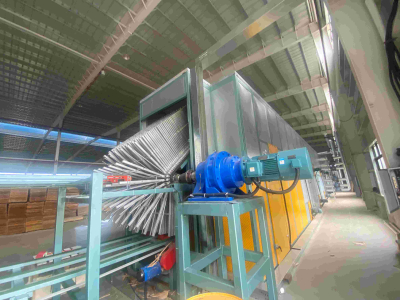
Shine Machinery publishes dryer configurations that support 0.8–8 mm veneer. One listed configuration includes a 4.5 m working width, 36 m heating area length, 180 m³/day drying capacity, fresh veneer drying to about 0–15% moisture content, and a biomass burner as the heat source, with other heat-source options available.
While these figures are handy for shortlisting a Wood Veneer Dryer, they aren't a one-size-fits-all operating recipe. A thin face veneer and a thicker core veneer may demand different drying treatments. Hardwood and softwood often behave differently during drying. Even within the same mill, incoming veneer moisture can vary based on log condition, storage time, and peeling schedule.
Buyers really need to ask not just if a veneer dryer can handle a certain thickness, but if it can be specifically set up and fine-tuned for their actual plywood production needs.
What Sample Drying Helps Confirm
A sample drying trial transforms general equipment specs into practical operating settings. Instead of assuming that the full thickness range will perform the same way, the mill can test representative veneer and review the drying outcome before moving into routine production.
Before a sample run, a plywood producer should prepare several pieces of information:
Wood species and whether the veneer is hardwood or softwood
Minimum, maximum, and commonly processed veneer thickness
Incoming moisture content and required final moisture content
Daily or hourly capacity target
Preferred heat source, such as biomass, gas, steam, electric heating, or heat pumps
Site conditions, including high humidity, high altitude, or cold-region requirements
Shine Machinery’s customized design service considers wood type, moisture requirements, and production capacity. Its service information also lists flexible heat-source configuration and adaptation for high-humidity, high-altitude, and cold-region working conditions. This makes sample drying especially useful for mills that process mixed veneer specifications rather than one stable product every day.
How Shine Machinery Structures the Trial Process
Shine Machinery describes a project path that moves from pre-demand analysis to 3D program design, customer confirmation, production quality control, and installation training. This sequence is key, seeing as veneer drying is as much about equipment choice as it is about process control.
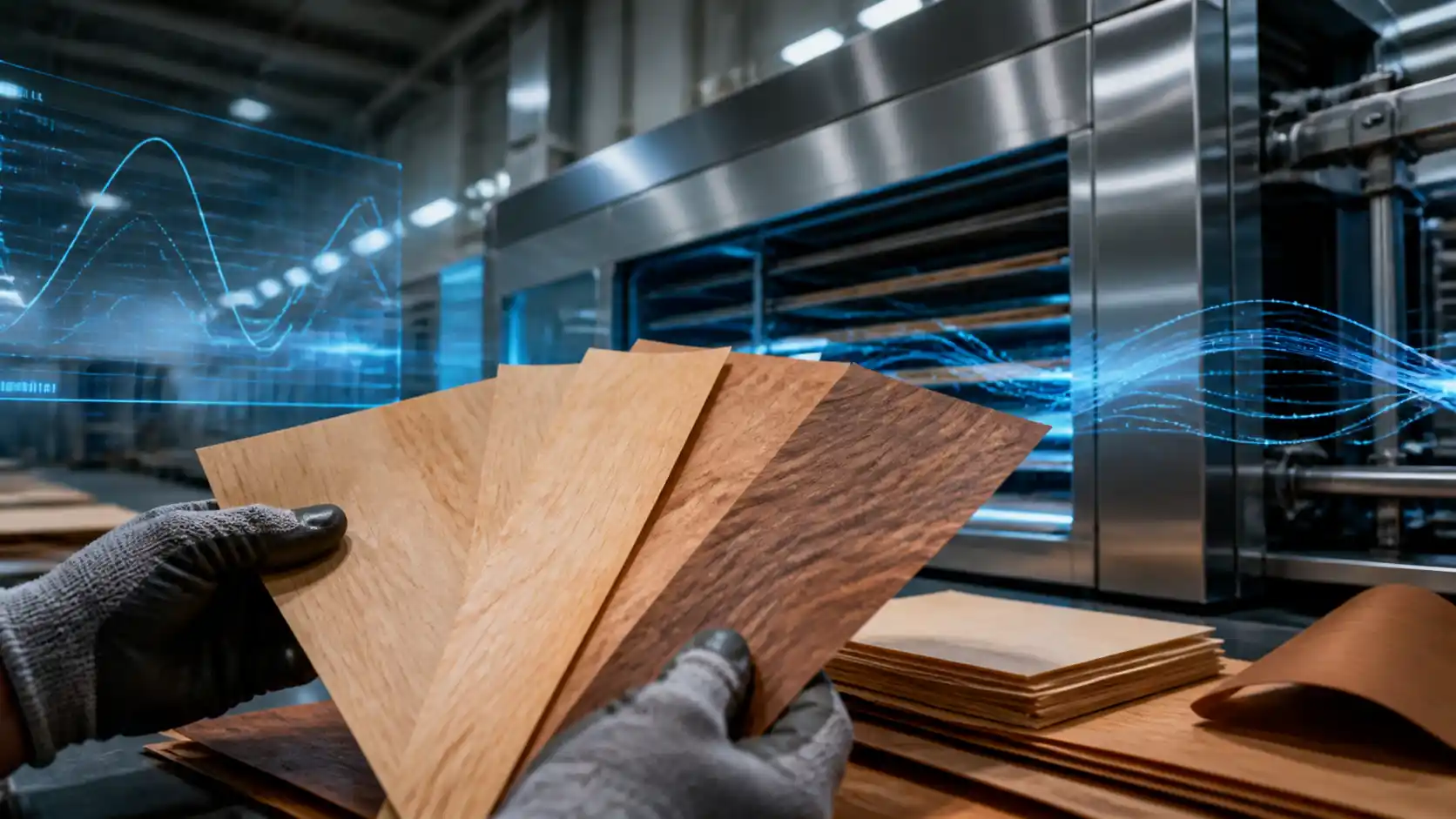
During installation and commissioning, Shine Machinery engineers conduct test runs with sample veneer. The purpose is to calibrate temperature profiles, airflow velocity, and conveyor speed, then fine-tune the dryer toward the moisture content required by the customer’s products. For a plywood mill, this is more meaningful than relying only on nominal capacity.
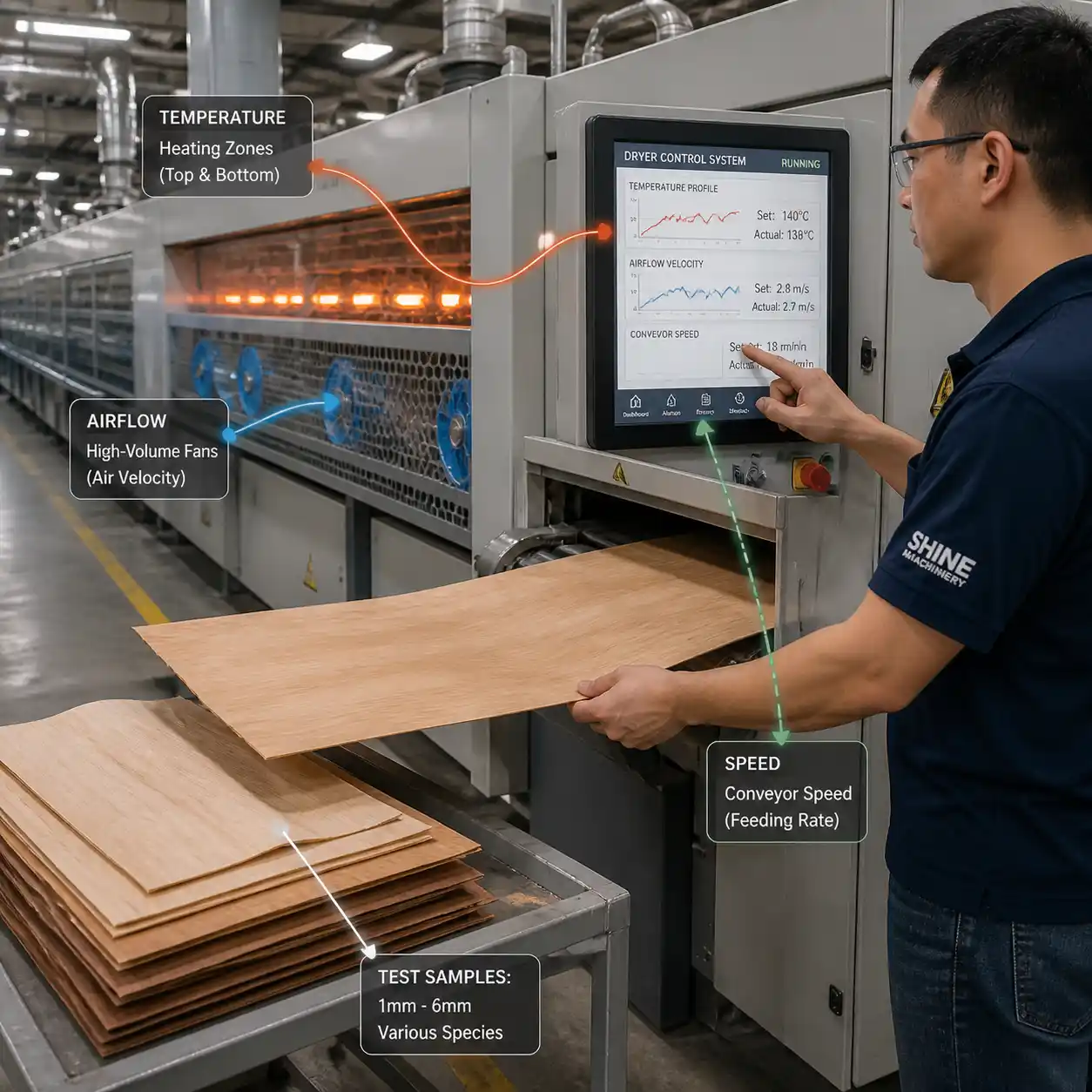
The company also specifies a 72-hour continuous operation test, moisture-content uniformity acceptance, and test reports. Operator training covers equipment operation, routine maintenance, and troubleshooting. Really, the trial isn't just to show a wood drying machine can operate; it's about nailing down drying settings that operators can reliably use long after the engineers depart.
Direct Order Compared With Sample Drying First
| Evaluation point | Direct equipment selection | Sample veneer drying first |
|---|---|---|
| Thickness suitability | Based mainly on stated range | Checked with actual veneer samples |
| Moisture result | Estimated from requirements | Reviewed against target moisture needs |
| Dryer adjustment | Confirmed during commissioning | Temperature, airflow, and conveyor speed calibrated earlier |
| Operating stability | Not proven by capacity alone | Supported by continuous operation testing |
| Rework risk | Higher when veneer conditions vary | Lower when settings match real production conditions |
The distinction becomes stark when dealing with a varied veneer mix. If a plant dries only one stable veneer type, standard configuration may be simpler to define. If the plant shifts between thin and thick veneer, or between different species, sample drying gives decision-makers a clearer basis for selecting the right wood drying machine configuration.
Operating Cost Should Be Treated as Project Specific
Shine Machinery’s published 0.8–8 mm configuration lists a composite operating cost of $6–12/m³, including labor, fuel, and electricity. This offers a helpful benchmark for buyers to compare dryer economics, yet the real cost assessment must align with specific project conditions.
Capacity, raw veneer moisture, target final moisture, heat source, and local operating environment all impact drying economics. A plant using biomass may evaluate fuel differently from a plant considering steam, gas, electric heating, or heat pumps. For this reason, sample drying and commissioning help connect the purchase decision with the conditions the machine will face in daily plywood production.
What Buyers Should Accept Before Full Production
Final acceptance should go beyond merely checking the nameplate of a veneer dryer machine. A robust acceptance process should confirm the chosen configuration aligns with the agreed production conditions.
Key points include:
Final moisture content meets the plywood production requirement
Moisture uniformity is accepted under agreed testing conditions
The machine completes the required continuous operation test
Capacity is reviewed under the agreed veneer and moisture conditions
Operators understand routine operation, maintenance, and troubleshooting
Shine Machinery also describes quality control from raw-material procurement to finished-product delivery, machine inspection before dispatch, overseas installation and debugging, and training for first-line operators. For buyers assessing a China veneer dryer manufacturer or supplier, this workflow underscores a smart procurement rule: don't just buy based on thickness range; verify how the dryer performs with the exact veneer your mill uses.
Buying Checklist for Plywood Mills
Before committing to a large Veneer Dryer Machine, prepare a concise production brief. Include veneer species, real thickness range, incoming moisture, target moisture, required capacity, preferred heat source, and site conditions.
Mills seeking a top China veneer dryer factory should pay close attention to the sample drying process. A supplier that discusses test veneer, dryer calibration, continuous testing, and operator training can help buyers make a more informed decision. Shandong Shine Machinery Co., Ltd provides customized veneer drying project design, installation, and commissioning services through www.veneersdryer.com.
FAQs
Can Shine Machinery dryers handle 0.8–8 mm veneer?
Yes. Shine Machinery lists multiple dryer configurations with a 0.8–8 mm veneer thickness range. The suitable configuration still depends on species, moisture requirements, heat source, and capacity.
Why is sample drying recommended before ordering?
Because the same thickness range can include very different drying conditions. Sample veneer helps engineers adjust temperature profiles, airflow velocity, and conveyor speed toward the required moisture result.
What does commissioning include?
Shine Machinery describes sample test runs, performance optimization, a 72-hour continuous operation test, moisture-content uniformity acceptance, and operator training.
Which heat sources can be considered?
Shine Machinery lists biomass, gas, steam, electric heating, and heat pumps as heat-source options for customized dryer configuration.
Is the published $6–12/m³ cost fixed for every project?
No. The $6–12/m³ figure is a published reference for specified configurations and includes labor, fuel, and electricity. Actual economics should be reviewed against project conditions.