
Fan Power Can Decide Your Veneer Dryer Budget
For plywood mills operating lengthy shifts, the initial purchase price of a Roller Veneer Dryer is merely the starting point on the financial ledger. Electricity expenses recur every operating hour, meaning fan configuration can become a pivotal element in the five-year budget. Shine Machinery's product parameters clearly illustrate why buyers should meticulously compare total installed power, actual kWh per hour, drying capacity, and the heat-source design before committing to a veneer dryer machine.

Installed Power Versus Actual Electricity Bills
Installed power indicates the total motor capacity included in a wood drying machine. However, actual electricity consumption tells a more direct story: the kilowatt-hours a veneer dryer machine is anticipated to use per operating hour. When combined with capacity, this completes the picture, revealing how much dried veneer is produced for that specific energy input.
Consider the GTH45-40 veneer drying model as an example. Its product parameters specify 228.5 kW total power, yet its actual electricity consumption stands at about 160 kWh per hour. This model boasts a drying capacity of 180–200 m³ per 24 hours, capable of drying fresh veneer to approximately 8–10% moisture content.
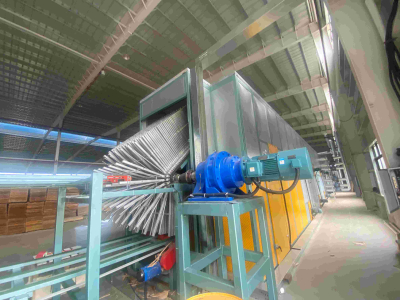
Much of that installed power is directly linked to air movement:
| GTH45-40 fan group | Configuration | Installed power |
|---|---|---|
| Hot air blower | 18 × 8 kW | 144 kW |
| Cold air blower | 4 × 4 kW | 16 kW |
| Air intake fan | 2 × 11 kW | 22 kW |
| Combined fan power | — | 182 kW |
| Total machine power | — | 228.5 kW |
For any plywood plant evaluating Plywood Veneer Drying equipment, these figures underscore a crucial point: fans are far from minor accessories. They are integral to the electrical consumption profile of a veneer dryer machine.
Axial Flow Fans and Biomass Heating Address Different Costs
Shine Machinery highlights that the hot air blower and cold air blower in the GTH45-40 veneer drying machine incorporate the latest axial flow blower technology. This design reduces the overall machine power consumption by 35% while effectively maintaining the required air volume for drying. Another Roller Plywood Veneer Dryer machine product page notes that axial flow fans can cut whole-machine power consumption by 38% compared to traditional dryers.
These efficiency improvements are most impactful when electricity costs are a significant concern. A veneer drying machine might seem attractive based solely on its purchase price, but the fan load continuously affects operating costs, hour after hour. Therefore, buyers assessing a China veneer dryer manufacturer or supplier should always request actual kWh/h consumption data, not just the installed kW.
Biomass heating, on the other hand, targets a distinct cost category. Shine Machinery's product descriptions detail biomass burners that utilize waste wood, wood chips, bark, and other factory residues as heating material. This innovative approach can substantially reduce fuel expenses, while the axial flow fan configuration and frequency-controlled motors tackle the electrical side of operation. In practical budgeting scenarios, it is essential to calculate fuel costs and power costs separately.
Comparing kWh per Hour with Output Capacity
A productive veneer dryer machine comparison begins by examining three key figures: actual electricity consumption, drying capacity, and target moisture content. The following Shine Machinery models are all designed to dry fresh veneer to approximately 8–10% moisture content.

| Model | Total power | Actual electricity consumption | Published capacity |
|---|---|---|---|
| GTH30-20 | 145.5 kW | About 100 kWh/h | 2.5 m³/h |
| GTH30-38 | 220.5 kW | Approximately 155 kWh/h | 120–130 m³/day |
| GTH45-40 | 228.5 kW | About 160 kWh/h | 180–200 m³/day |
| GTH30-50 | 276.5 kW | About 190 kWh/h | 6.5 m³/h |
The takeaway is clear: the lowest installed power does not automatically translate to the lowest operating cost per cubic meter. A higher-capacity Roller Veneer Dryer might consume more electricity per hour, but it could also produce a significantly greater volume of dried veneer in the same timeframe. For effective five-year planning, procurement teams ought to evaluate actual kWh/h against their specific production targets.
Estimating Five-Year Electricity Costs
A straightforward formula often suffices to compare various options before soliciting a final quotation. Let E represent actual electricity consumption in kWh/h, H represent annual operating hours, and T represent the local electricity tariff per kWh.
Annual electricity cost = E × H × TFive-year electricity cost = E × H × T × 5
Applying this formula using the published consumption figures, the calculation for the GTH45-40 model becomes:
Five-year electricity cost = 160 × H × T × 5
For the GTH30-38, the calculation is:
Five-year electricity cost = 155 × H × T × 5
This method integrates the buyer’s local conditions into the calculation. Factors such as electricity tariffs, operating hours, veneer species, veneer thickness, initial moisture content, and target moisture levels all impact the ultimate business outcome. Consequently, a professional wood drying machine purchase should involve comparing power demand and output under consistent operating assumptions.
Key Questions Before Choosing a Supplier
When shortlisting a leading China veneer dryer factory, buyers can streamline the comparison process by requesting the same information from each potential supplier. The most valuable questions focus on energy usage, drying quality, and practical operational aspects, rather than just machine length or price.
What is the actual electricity consumption in kWh per hour?
What drying capacity can be expected under specified veneer thickness and moisture conditions?
How many hot air blowers, cold air blowers, and air intake fans are included?
Are axial flow fans utilized in the proposed configuration?
Which motors feature frequency control?
What heat source is recommended: biomass burner, steam, natural gas, thermal oil, or another alternative?
What is the target final moisture content for Plywood Veneer Drying?
Can working width, number of working layers, or heating length be customized to fit the mill layout?
Shine Machinery's product pages highlight automatic temperature control and speed regulation across numerous models, with veneer transport speed typically ranging from 5–22 m/min. For buyers, this implies that the control system should be evaluated in conjunction with the fan configuration, heat source, and overall drying capacity.
The Practical Procurement Takeaway
If electricity becomes the primary cost driver, the fan system within a Roller Veneer Dryer can impact the five-year budget far more than many buyers initially anticipate. The pertinent comparison isn't simply, "which veneer dryer machine has the lowest purchase price?" Rather, it's "which machine consistently produces the required volume of dried veneer at the most advantageous kWh/h, desired moisture result, and optimal heat-source cost?"
For mills already leveraging waste wood via a biomass burner, the next cost-saving discussion often centers on optimizing air movement and electrical control. This is precisely where axial flow fans, real electricity consumption data, and capacity matching become central to a sound Plywood Veneer Drying investment.
FAQs
Does lower installed power always guarantee lower operating costs?
Not necessarily. Installed power should always be evaluated alongside actual kWh/h consumption and the machine's drying capacity. A larger veneer dryer machine might consume more power per hour but could also yield a greater volume of dried veneer in the same timeframe, leading to a lower cost per cubic meter.
What specific costs does the biomass burner help reduce?
The biomass burner primarily reduces heating costs. Shine Machinery's documentation indicates that waste wood, wood chips, bark, and other factory residues can be used as heating materials. Fan configuration, in contrast, mainly influences electricity consumption.
What final moisture content do the models mentioned target?
The GTH30-20, GTH30-38, GTH45-40, and GTH30-50 models are designed to dry fresh veneer to a target final moisture content of approximately 8–10%.
Why are axial flow fans significant in a Roller Veneer Dryer?
Air movement accounts for a substantial portion of a dryer's installed power. Shine Machinery's product pages indicate that axial flow blower configurations can reduce the whole-machine power consumption by 35% or even 38%, depending on the specific model.
What should buyers prioritize when electricity costs are high?
When electricity costs are a major concern, buyers should start by comparing actual kWh/h consumption, drying capacity, fan configuration, and the target moisture conditions. These figures offer a more accurate representation of operational costs than just the purchase price.