
Grow Core Veneer Output Without Expanding the Workshop
Many plywood mills find their drying section becomes a bottleneck, slowing down overall production. While adding more building space might seem like the obvious solution, it's not always the most practical one. A Vertical Veneer Dryer changes the capacity discussion by using three-dimensional veneer loading, helping mills increase core veneer loading volume within a smaller workshop footprint. Shine Machinery states that its vertical core veneer dryer occupies about two-thirds of the area of a roller dryer and increases veneer loading capacity by 30–80% compared with other dryers.

Why Three-Dimensional Loading Matters
Traditional capacity planning often starts with a simple question: where can another drying line fit? For workshops with limited usable floor area, that question can lead directly to significant construction costs, layout disruption, and longer project planning. Three-dimensional loading offers a different route. Instead of relying only on horizontal expansion, the vertical arrangement significantly increases the quantity of veneer that can be loaded into the drying equipment.
That's why the Vertical Core Veneer Dryer Machine is so relevant for core veneer production. Its compact area requirement and higher loading capacity make it particularly suitable for mills that aim to improve plywood veneer drying output without immediately committing to a larger building.
Comparing Vertical Capacity With Roller Dryer Expansion
While a roller dryer remains a common solution in plywood production, adding roller-dryer capacity usually requires a careful review of workshop length, infeed and outfeed space, fuel arrangement, labor flow, and maintenance access. A vertical veneer dryer approaches the same production pressure from a different angle: it raises loading density while simultaneously reducing the required footprint.
Shine Machinery lists several practical figures for its vertical dryer system:
Footprint: Approximately two-thirds of the area of a roller dryer.
Loading capacity: 30–80% higher than other dryers.
Drying cost: Less than $8/m³, stated as 30–60% of the drying cost of other dryers.
Installation: Assembled directly at the customer’s factory site and installed according to specific location requirements.
Of course, these points don't mean every drying project needs the same setup. But they do suggest that a compact veneer dryer deserves a closer look before a mill concludes that expansion is its only option.
How the Vertical Veneer Drying System Works
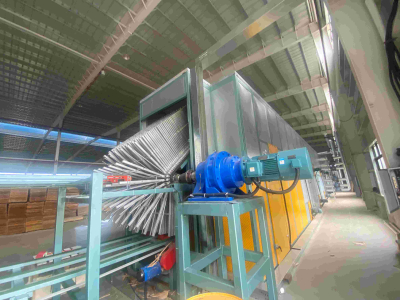
The vertical veneer drying machine is composed of four main parts: the feeding area, heating area, cooling area, and discharging area. During operation, a chain brings the veneer or finished board into the drying room for circulating drying. This structure supports continuous core veneer drying while keeping the equipment layout compact.

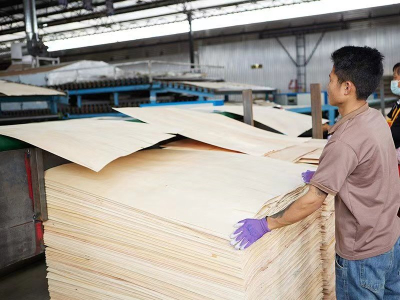
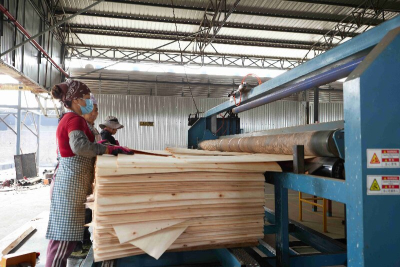
Inside, the Vertical Veneer Drying process from Shine Machinery boasts uniform airflow, steady temperatures, ample hot-air volume, and a countercurrent drying cycle. The machine is mainly used for drying core board, partial surface board, and bottom board. It is also well-suited for the production process of cutting first and then drying, particularly for thick veneer.
Read Capacity Together With Moisture Conditions
When selecting a veneer dryer machine, the headline output figure alone isn't enough. In plywood veneer drying, production capacity is closely tied to incoming moisture content, final moisture target, veneer thickness, temperature, and airflow conditions. You shouldn't compare a machine rated for one final moisture target directly with another model operating under different conditions.
The following Shine Machinery model parameters show why the final moisture target matters:
| Parameter | FBH30-20 | FBH30-13 |
|---|---|---|
| Moisture condition | Fresh veneer to within 20% | Fresh veneer dried to 0–5% |
| Output | 1.2–1.5 m³/h | 2 m³/h |
| Machine size | 20 × 7 × 4 m | 13 × 3 × 4 m |
| Total power | 36.3 kW | 15 kW |
| Labor | 3 workers | — |
| Fuel consumption | — | 200 kg/h |
The FBH30-20 should therefore not be viewed simply as a lower-output choice. Its published output is tied to a different moisture condition. For the FBH30-20, Shine Machinery also notes that the burner operator can work concurrently with other tasks, such as operating a forklift. For the FBH30-13, the listed parameters include 200 kg/h fuel consumption.
When a Low Cost Veneer Dryer Makes Practical Sense
A Low Cost Veneer Dryer Machine isn't just about the initial purchase price. In a working plywood mill, cost also includes the space taken by the machine, the drying cost per cubic meter, labor arrangement, and whether the system fits the current production sequence.
For mills drying thick core veneer or using a cut-first-then-dry process, the vertical dryer’s intended application is especially important. Drying veneer effectively requires matching the machine to the veneer type, moisture target, plant layout, and required hourly output. Ultimately, a low-cost option only proves its worth when it also supports stable production planning.
A Practical Checklist Before Expanding the Workshop
Before adding floor area or installing another line, mills can define their drying requirement more precisely. A useful review should include:
Current workshop dimensions and available installation position.
Required core veneer output in m³/h.
Fresh veneer moisture and target final moisture content.
Veneer thickness and whether thick core veneer is involved.
Production sequence, especially cut-first-then-dry processing.
Installed power, labor arrangement, and fuel consumption.
Expected drying cost per cubic meter.
Space needed for feeding, cooling, discharging, and material handling.
This checklist transforms the vague idea of “more capacity” into a measurable equipment decision. It also helps buyers compare a veneer dryer manufacturer or supplier based on technical suitability, rather than just headline capacity.
Capacity Should Come Before Construction
For core veneer production, the better question isn't always about building a larger workshop. Instead, it's about whether the existing drying area is optimized to match the required output, moisture target, and specific veneer application.
Shine Machinery’s vertical veneer dryer offers a tangible solution for mills facing space constraints: three-dimensional loading, approximately two-thirds of the area of a roller dryer, a stated 30–80% increase in veneer loading capacity compared with other dryers, and drying cost below $8/m³. For buyers evaluating a veneer dryer machine for plywood core production, these figures position the vertical Veneer Drying System as a practical alternative to simply expanding blindly.
For those exploring Vertical Veneer Dryer solutions, plywood veneer drying layouts, and compact systems for drying veneer in core board production, Shandong Shine Machinery Co., Ltd offers detailed product information on their website: www.veneersdryer.com.
FAQs
Why can a Vertical Veneer Dryer improve capacity in a limited workshop?
It utilizes three-dimensional veneer loading, and Shine Machinery states that its vertical core veneer dryer occupies about two-thirds of the area of a roller dryer while increasing loading capacity by 30–80% compared with other dryers.
Is the vertical dryer suitable for thick core veneer?
Yes. Shine Machinery describes the vertical veneer drying machine as suitable for core board drying and especially for thick veneer in a cut-first-then-dry production process.
What is the stated drying cost of Shine’s vertical dryer?
Shine Machinery states that the drying cost is less than $8/m³, which is described as 30–60% of the drying cost of other dryers.
Can buyers compare veneer dryer models by output only?
No. Output should be read together with initial moisture, final moisture target, machine size, power, labor, and fuel consumption. Different moisture targets can significantly change how capacity should be interpreted.
How does veneer move through the vertical drying system?
A chain brings the veneer or finished board into the drying room for circulating drying. The system includes distinct feeding, heating, cooling, and discharging areas.